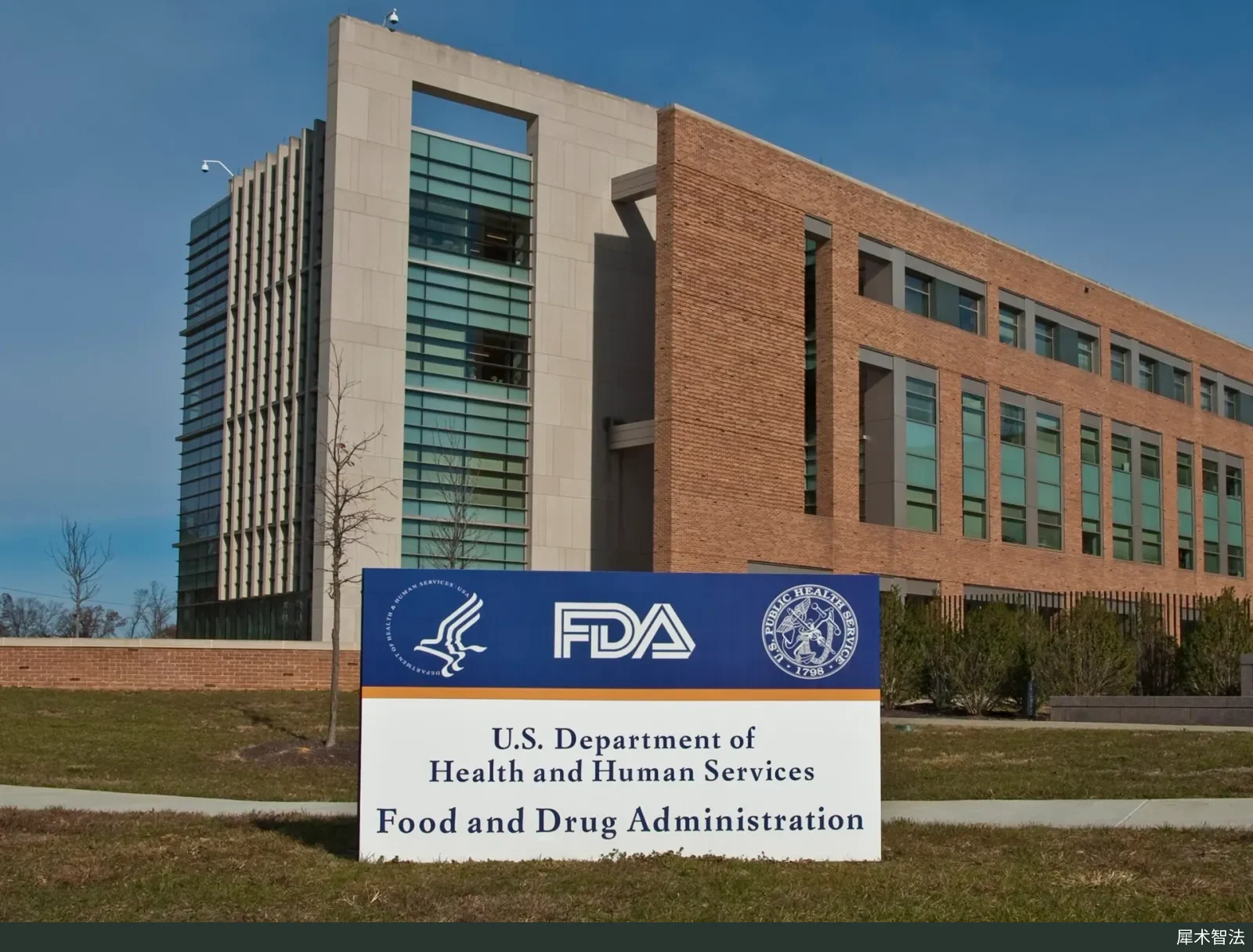
The sign at the main entrance of the FDA's White Oak campus in Silver Spring, Maryland, with Building 21 behind it (photographed in 2010). Photo: U.S. Food and Drug Administration (FDA); source: Wikimedia Commons; license: work of the U.S. federal government, public domain.

On October 20, 2026, Rick Abramson, director of the U.S. FDA's Digital Health Center of Excellence, said at a medical device industry conference in Boston that generative AI medical devices may need to undergo competency assessment the way physicians do, and said the FDA intends to draft policy guidance within a few months. So far, this approach appears only in a discussion paper released in August and in officials' remarks at the event. It has not yet become draft guidance or a rule in effect.
Abramson's Conference Remarks
According to an on-site report by MedCity News reporter Arundhati Parmar on October 20, Abramson took part in a panel discussion that day at The MedTech Conference, hosted in Boston by the industry association AdvaMed. The moderator was Geeta Pamidimukkala, AdvaMed's vice president for technology and regulatory affairs. A radiologist by training, Abramson is currently director of the Digital Health Center of Excellence (DHCoE) within the FDA's Center for Devices and Radiological Health (CDRH).
He used radiology to illustrate why the old approach falls short. A traditional AI device takes a chest X-ray as input and outputs a binary signal such as “pneumothorax present/absent,” so the evidence requirements are relatively straightforward. For generative AI, both the inputs and the outputs are unbounded text, which he called an “unbounded evaluation space,” and the FDA “does not yet have methods for this kind of evidence demonstration.” He said such devices behave “more like me, the physician, than like a heart valve or a defibrillator”: a physician's knowledge, clinical judgment, communication skills, and ability to stay within safety boundaries are assessed over a long period, and no one requires a physician to first look at every chest X-ray they might encounter over their career.
On next steps, Abramson said the FDA “intends to move toward policy and to draft policy,” that the discussion paper is “not just an academic paper,” and that the current administration has made this work a priority at the level of both the Secretary of Health and Human Services (HHS) and the White House. He gave no specific date, saying only “not weeks, and certainly not years,” and said he expects a draft policy guidance to be released within a few months, followed by another round of public comment. All of the above are oral statements made by an official at the conference and are quoted from media reports. This article did not find a transcript of the remarks published by the FDA.
Scope and Nature of the August Discussion Paper
The document Abramson referred to is the FDA's “Considerations for the Regulation of Generative AI-Enabled Medical Devices: Discussion Paper and Request for Feedback,” released on August 18, 2026. Led by DHCoE, it collected comments on Regulations.gov under docket number FDA-2026-N-7874, with a deadline of October 19. According to the FDA press release, the paper addresses four areas: risk assessment, premarket evaluation, postmarket monitoring, and other topics such as foundation models and agentic AI systems.
The paper targets “generative AI-enabled medical devices,” meaning products that are themselves medical devices and that use generative AI, not all AI used in healthcare settings. It proposes a two-axis risk framework: one axis looks at how independent the device's activity is, and the other looks at the potential consequences of relying on erroneous output. According to a summary of the paper by the law firm Crowell & Moring, the activity axis has four tiers: informational and not directing action (such as providing a risk score for future cardiovascular events), informational but directing action (such as strongly worded advice to go to the emergency department), taking action under the supervision of healthcare professionals, and taking action fully autonomously. The consequence axis acts as a modifier. Even when both involve placing orders autonomously, prescribing antibiotics for confirmed strep throat does not carry the same risk as initiating a thrombolytic therapy order in a stroke protocol.
The premarket section is the “physician-like” approach Abramson described. The FDA press release says this competency assessment scheme is “at a high level inspired by how physicians are trained and evaluated,” and that it consists of two parts: non-clinical device benchmarking and clinical validation. The law firm's analysis further notes that what is evaluated is the device as configured for actual deployment and as ultimately delivered to users, not the foundation model in isolation. Clinical validation may take the form of retrospective evaluation, shadow deployment, or standardized patient interactions, up to prospective clinical studies or randomized controlled trials, chosen according to risk.
The paper states its legal nature clearly. The FDA page declares that it is for discussion only, does not constitute draft or final guidance, does not propose or implement changes in regulatory policy, and does not express CDRH's expectations regarding evidence for future marketing submissions. Nor does the paper address whether these ideas fall within the FDA's existing statutory authority or would require new legislative authorization.

Timeline related to the FDA's discussion paper on generative AI medical devices. The dashed line indicates a date that has not been set, and the spacing between nodes is not proportional to time. Drawn by this site with Graphviz code (rendered via QuickChart); sources: FDA press release (2026-08-18), AMA letter (2026-10-16), and MedCity News report (2026-10-20).
Relationship to Existing Device Regulatory Pathways
This paper has not changed the current rules. The FDA explains on its AI medical devices page that it does not regulate “AI itself.” Instead, it regulates medical devices under the Federal Food, Drug, and Cosmetic Act (FD&C Act). The definition of a device includes software, except for certain software functions excluded under Section 520(o) of the Act. AI products that are devices still go through established pathways such as 510(k) premarket notification, De Novo classification, or premarket approval (PMA). Products that involve algorithm updates may submit a plan under the finalized “Predetermined Change Control Plan” (PCCP) guidance together with their marketing submission. The FDA says that as of September 2026, more than 1600 AI medical devices had been authorized for marketing in the United States.
The discussion paper mainly addresses the methods for “demonstrating safety and effectiveness,” not legal classification or market pathways. MedCity News described competency assessment as a departure from how the FDA has evaluated software as a medical device (SaMD) for twenty years; this is the reporter's characterization. The law firm's analysis notes that the postmarket monitoring envisioned in the paper (periodic re-benchmarking, sampled review by clinicians, and monitoring for performance degradation) may be built around PCCPs. The U.S. Chamber of Commerce also stressed in its submitted comments that the two-axis framework should be used only for risk management and evidence expectations and should not become a de facto new classification system. In its view, device classification, substantial equivalence determinations, and market pathways should still be governed by existing regulations.
Feedback from Physician and Industry Groups
John Whyte, chief executive officer of the American Medical Association (AMA), wrote to Abramson on October 16. The letter broadly supports the FDA's exploration of a competency assessment approach based on “benchmarking plus clinical validation,” but sets out two principles. First, regulatory flexibility must not come at the cost of lowering the “reasonable assurance of safety and effectiveness.” Second, physicians' expertise should be used to set standards, not to serve as a backstop safety net. The AMA argues that if physicians are the reference point, accountability should come along with that comparison: “Neither the probabilistic nature of generative AI outputs nor the inability to test every possible scenario should allow responsibility to be diffused among clinicians, patients, deploying organizations, foundation model developers, or other participants in the ecosystem.” The AMA also explicitly opposes lowering premarket evidence requirements on the grounds that postmarket monitoring will be strengthened, out of concern that this would shift risk and legal liability onto physicians. It also argues that agentic systems require a higher degree of testing and review.
Industry groups focus more on predictability and compliance burden. The U.S. Chamber of Commerce's October 19 comments support the two-axis approach but ask the FDA to provide objective criteria for placing devices on the axes, along with examples across clinical domains. The Chamber argues that evaluation should focus on performance on specific tasks for specific intended uses rather than on “competency” in general. It recommends developing benchmarks jointly with standards organizations such as AAMI, IEEE, HL7, and ISO, and it contends that low-risk and moderate-risk devices should be able to accept binding postmarket monitoring plans in exchange for a lighter premarket burden. The Consumer Technology Association (CTA), in comments submitted the same day, calls postmarket monitoring the most important and most difficult part of the entire framework. It recommends building on the existing PCCP framework rather than creating a separate one, and asks the FDA to confirm that agentic systems performing non-device functions such as medical record documentation and scheduling are not subject to device regulation. Both groups recommend addressing agentic AI separately.
Several matters remain undetermined: the specific release date of the draft guidance, whether the formal text will keep the “competency assessment” design, and how the disagreement between physician groups and industry groups over the premarket evidence threshold will be resolved. The figure of “more than 300 comments” comes from Abramson's remarks at the event; this article did not check the public docket item by item.
References
-
U.S. Food and Drug Administration. FDA Seeks Public Feedback to Inform Regulatory Approach for Generative AI-Enabled Medical Devices. 2026-08-18.
-
U.S. Food and Drug Administration. Considerations for the Regulation of Generative AI-Enabled Medical Devices: Discussion Paper and Request for Feedback. 2026-08-18. Docket No. FDA-2026-N-7874.
-
U.S. Food and Drug Administration. Artificial Intelligence-Enabled Medical Devices. The page does not show a publication date; accessed 2026-10-23.
-
Arundhati Parmar. FDA Official Believes GenAI-enabled Tools Will Need to Be Assessed Like a Physician. MedCity News, 2026-10-20.
-
John Whyte, American Medical Association. Letter to Rick Abramson re: Considerations for the Regulation of Generative AI-Enabled Medical Devices. 2026-10-16.
-
U.S. Chamber of Commerce. Re: Docket No. FDA-2026-N-7874 – Considerations for the Regulation of Generative AI-Enabled Medical Devices. 2026-10-19.
-
Consumer Technology Association. CTA Comments - FDA Gen AI Discussion Paper 2026. 2026-10-19.
-
Crowell & Moring LLP. FDA Proposes GenAI Medical Device Regulatory Framework: What Manufacturers Need to Know. 2026-09-03.
-
Xishu Zhifa · Law: the art of the rules of the game
-
Compiled and published by Scholay, a one-stop academic platform. If this infringes your rights, please let us know and it will be taken down.
-
Also published on Enter Scholar, a community for scholars in the age of intelligence.