The U.S. Copyright Office's Copyright and Artificial Intelligence report series currently lists three volumes on its website: Volume 1 addresses digital replicas (July 31, 2024), Volume 2 addresses the copyrightability of AI-generated content (January 29, 2025), and Volume 3 addresses generative AI training (pre-publication version released May 9, 2025). The reports are policy studies and recommendations provided to Congress, not legislation. As of October 23, 2026, the final version of Volume 3 had still not been released.
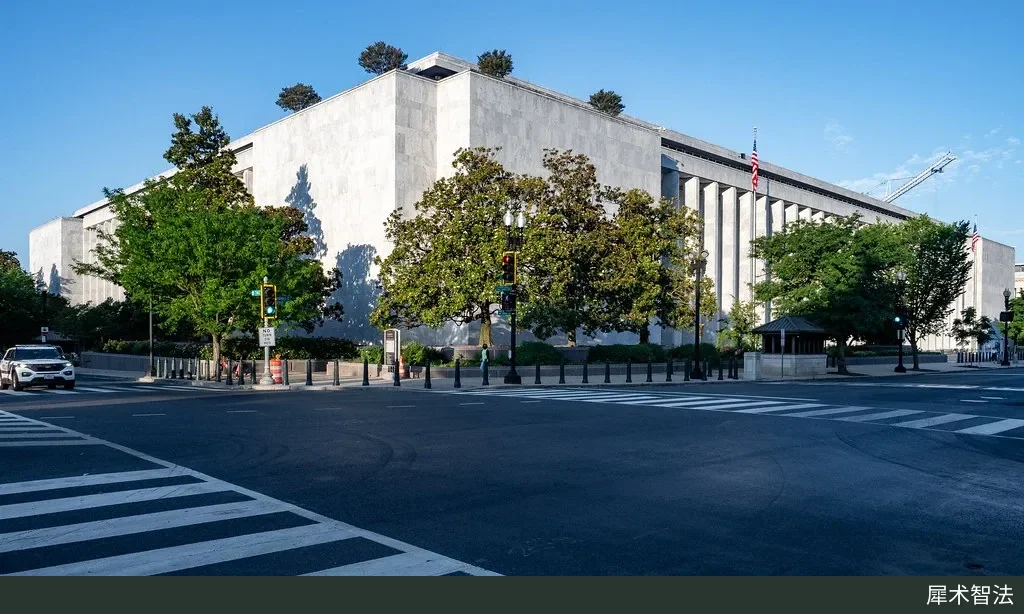
The James Madison Memorial Building of the Library of Congress, which houses the U.S. Copyright Office. Photo: ajay_suresh; source: Flickr; license: CC BY 2.0.
Nature of the Reports and Release Status
The Copyright Office launched a dedicated study of artificial intelligence in early 2023. It published a notice of inquiry in the Federal Register on August 30, 2023 (88 Fed. Reg. 59942), and by December 2023 it had received more than 1 ten-thousand public comments. The reports were written under Section 701(b) of Title 17 of the United States Code, which gives the Register of Copyrights the duties to “conduct studies” and to “advise Congress on copyright matters.” They are not laws, regulations, or court decisions. Volume 3 states in its introduction that the report does not express views on specific cases and offers only an analytical framework.
According to the Copyright Office's topic page, Volume 1, Digital Replicas (Part 1: Digital Replicas), was released on July 31, 2024. Volume 2, Copyrightability (Part 2: Copyrightability), was released on January 29, 2025. Volume 3, Generative AI Training (Part 3: Generative AI Training), was made public as a “pre-publication version” on May 9, 2025. The website says the early release responded to congressional inquiries and stakeholder interest, that the final version “will be published in the future,” and that no substantive changes to the analysis or conclusions are expected. As of a search on October 23, 2026, the website still offered only the pre-publication version of Volume 3, so everything in this article concerning Volume 3 is based on that version. Strictly speaking, the volumes of the series released in 2025 are Volumes 2 and 3; Volume 1 was released in 2024.
Official statements are inconsistent about whether further volumes will follow. The January 29, 2025 announcement of Volume 2 said that the report was being “issued in three parts.” However, a footnote in the pre-publication version of Volume 3 states that infringement liability for outputs and transparency requirements will be discussed in “Part 4.” As of the search date, the website did not list a Volume 4, and its release date and contents are unknown.
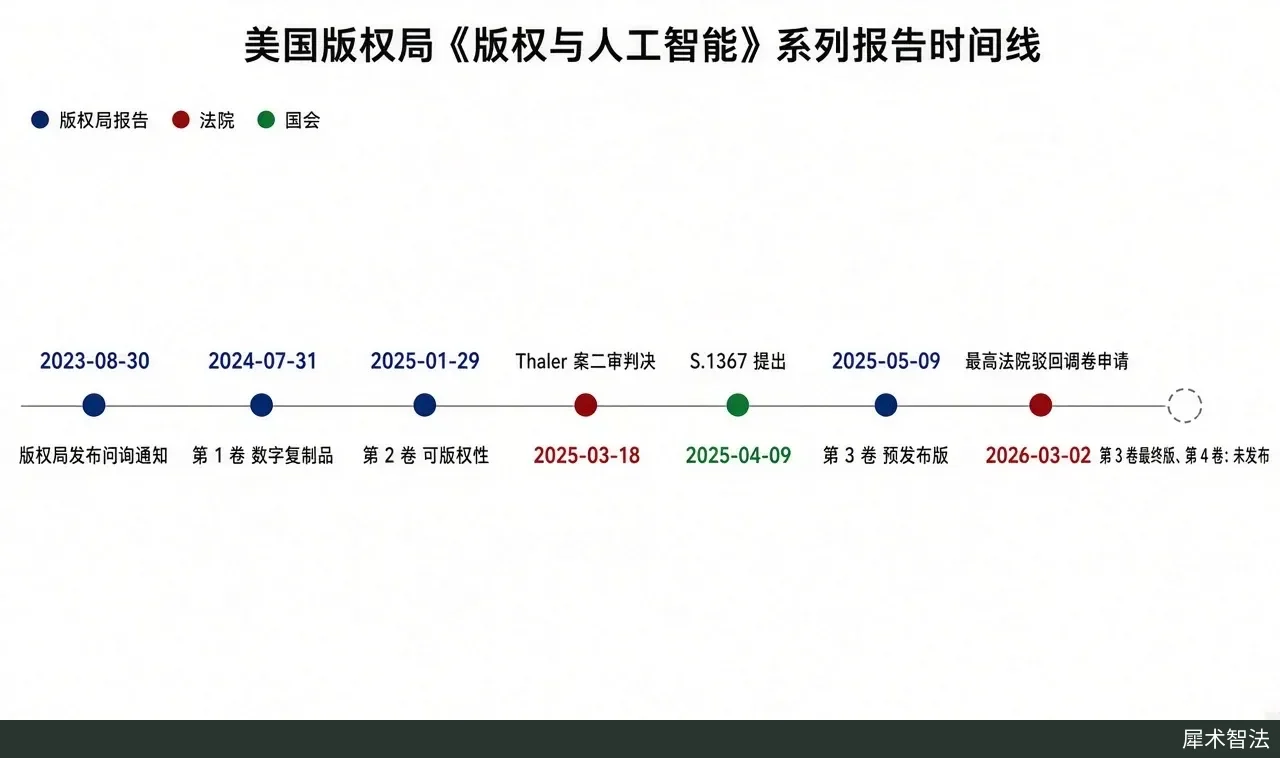
AI-generated illustration. A timeline of the U.S. Copyright Office's Copyright and Artificial Intelligence report series and related events. Dates were compiled from public information on the U.S. Copyright Office website, the decision of the D.C. Circuit Court of Appeals, the U.S. Supreme Court docket, and Congress.gov, as of October 23, 2026.
AI Training and Fair Use
Volume 3 first sets out which steps in generative AI development implicate reproduction and other exclusive rights, discussing data collection and curation, model training, retrieval-augmented generation (RAG), and outputs in turn. The report concludes that multiple stages of generative AI development use works in ways that implicate copyright owners' exclusive rights. The key question is whether these acts of prima facie infringement can be excused as “fair use.”
The report analyzes the four statutory factors. Under the fourth factor (the effect on the market for the work), it separately discusses lost sales, “market dilution,” and lost licensing opportunities. Its overall assessment is that outcomes in individual cases cannot be predicted in advance. Many uses in AI training are “likely to be transformative,” but whether they are fair depends on which works were used, where they came from, the purpose of the use, and what controls were placed on outputs. If a model is used for purposes such as analysis or research, its outputs are unlikely to substitute for the expressive works used in training. But “making commercial use of vast troves of copyrighted works to produce expressive content that competes with them in existing markets, especially where this is accomplished through illegal access,” goes beyond established fair use boundaries.
These are the Copyright Office's analytical views on current law, and courts are not bound by them. The report also states that its analysis is limited to the circumstances and public information available at the time. It notes that the technology and markets continue to change rapidly, and that the Office will keep monitoring developments to determine whether its conclusions need revision.
Copyrightability of Generated Content
Volume 2 concludes that the copyrightability questions raised by AI can be resolved under existing law, without legislative change. Specifically, using AI to assist human creativity, rather than replace it, does not affect a work's eligibility for protection. A human author's original expression in a work is protected, even if the work also contains AI-generated material. Content generated purely by AI, or content whose expressive elements a human did not sufficiently control, is not protected by copyright. Whether a human contribution is sufficient to constitute authorship must be determined case by case.
On prompts, the report finds that, given how generally available technology currently works, prompts alone do not provide enough control to make the user the author of the output. Prompts are essentially instructions that convey unprotectable ideas. On the other hand, where a human author's work is perceptible in AI output, or where a human has creatively selected, arranged, or modified the output, those portions can still be protected. The report also finds that the case for creating copyright or special (sui generis) protection for AI-generated content has not been made. It states that the Office will issue supplementary registration guidance and update the relevant portions of the Compendium of U.S. Copyright Office Practices (Compendium).
The related court case is Thaler v. Perlmutter. In his registration application, applicant Stephen Thaler listed the AI system he developed, the “Creativity Machine,” as the sole author of the visual work A Recent Entrance to Paradise, and listed himself only as the owner of the rights. The Copyright Office refused registration on the basis of the human authorship requirement. The U.S. Court of Appeals for the District of Columbia Circuit issued its decision on March 18, 2025 (No. 23-5233, opinion). The court held that the Copyright Act of 1976 requires a work to be authored in the first instance by a human being, and it upheld the refusal of registration. Thaler then petitioned the U.S. Supreme Court for a writ of certiorari (No. 25-449), which the Court denied on March 2, 2026 (docket page). That application listed AI as the sole author, which differs from the scenarios of “humans creating with the help of AI” that are the focus of Volume 2.
Licensing, Transparency, and Legislative Discussion
The fifth part of Volume 3 is devoted to training licenses. The report observes that some voluntary direct and collective licensing agreements have emerged, and that some AI systems have been trained entirely on licensed or public domain works. This shows that voluntary licensing is feasible in at least some contexts. Examples include high-value content that can be licensed in relatively large volumes (popular music, stock photography) and fields with a limited number of rightsholders. However, the report also acknowledges that the growth of licensing markets does not, by itself, prove that voluntary licensing can meet all training needs. The report says that antitrust concerns raised by collective licensing are outside the Copyright Office's expertise, and it encourages the U.S. Department of Justice to provide guidance, including on whether an antitrust exemption is needed.
On government intervention, the report finds that compulsory licensing for AI training has clear drawbacks and could lock in rates and industry practices. Where voluntary licensing truly does not work, extended collective licensing (ECL) is a less interventionist option. On “opt-out” mechanisms, the report finds that requiring rightsholders to opt out affirmatively is inconsistent with the basic principle that use requires consent. An opt-out mechanism might preserve some degree of control only if Congress were to consider creating an exception for AI training in the future. The report also notes in a footnote that merely complying with platform-level signals such as robots.txt is not sufficient. Its ultimate recommendation is to let licensing markets continue developing without government intervention for now. If market failure is shown for specific types of works in specific contexts, targeted interventions such as ECL could then be considered.
On transparency, the pre-publication version of Volume 3 makes no specific transparency recommendations. In describing the EU's Artificial Intelligence Act, the report mentions the Act's transparency requirements and says the issue will be discussed further in Part 4, which has yet to be released. Requirements such as training data disclosure obligations therefore cannot currently be described as recommendations the Copyright Office has already made.
The three volumes take different positions on legislation. Volume 2 expressly does not recommend legislative change. Volume 3 finds that government intervention now would be “premature,” given the relatively rapid growth of voluntary licensing and the general lack of stakeholder support for amending the law. Only Volume 1 makes a legislative recommendation to Congress: to enact a new federal law protecting everyone from harm caused by the knowing distribution of unauthorized digital replicas. In Congress, Senator Coons, together with Blackburn, Klobuchar, and Tillis, introduced S.1367, the NO FAKES Act of 2025, on April 9, 2025. The bill would create a federal right in an individual's voice and visual likeness and has been referred to the Senate Judiciary Committee. At the time of the search, the congressional website showed the bill still at the “Introduced” stage. Available public materials are insufficient to establish a direct relationship between this bill and Volume 1.
References
-
U.S. Copyright Office. Copyright and Artificial Intelligence (topic page, accessed October 23, 2026).
-
U.S. Copyright Office. NewsNet Issue 1048: Part 1 Digital Replicas release announcement, 2024-07-31.
-
U.S. Copyright Office. Copyright and Artificial Intelligence, Part 2: Copyrightability, 2025-01-29.
-
U.S. Copyright Office. NewsNet Issue 1060: Part 2 release announcement, 2025-01-29.
-
U.S. Copyright Office. Copyright and Artificial Intelligence, Part 3: Generative AI Training (Pre-Publication Version), 2025-05-09.
-
U.S. Court of Appeals for the D.C. Circuit. Thaler v. Perlmutter, No. 23-5233, 2025-03-18.
-
Supreme Court of the United States. Docket No. 25-449, Thaler v. Perlmutter (petition for certiorari denied 2026-03-02).
-
Congress.gov. S.1367 - NO FAKES Act of 2025, introduced 2025-04-09.
-
Xishu Zhifa · Law: the art of the rules of the game
-
Compiled and published by Scholay Academic One-Stop Platform. If this content infringes your rights, please let us know and it will be taken down.
-
Also published on Enter Scholar, a community for scholars in the age of intelligence