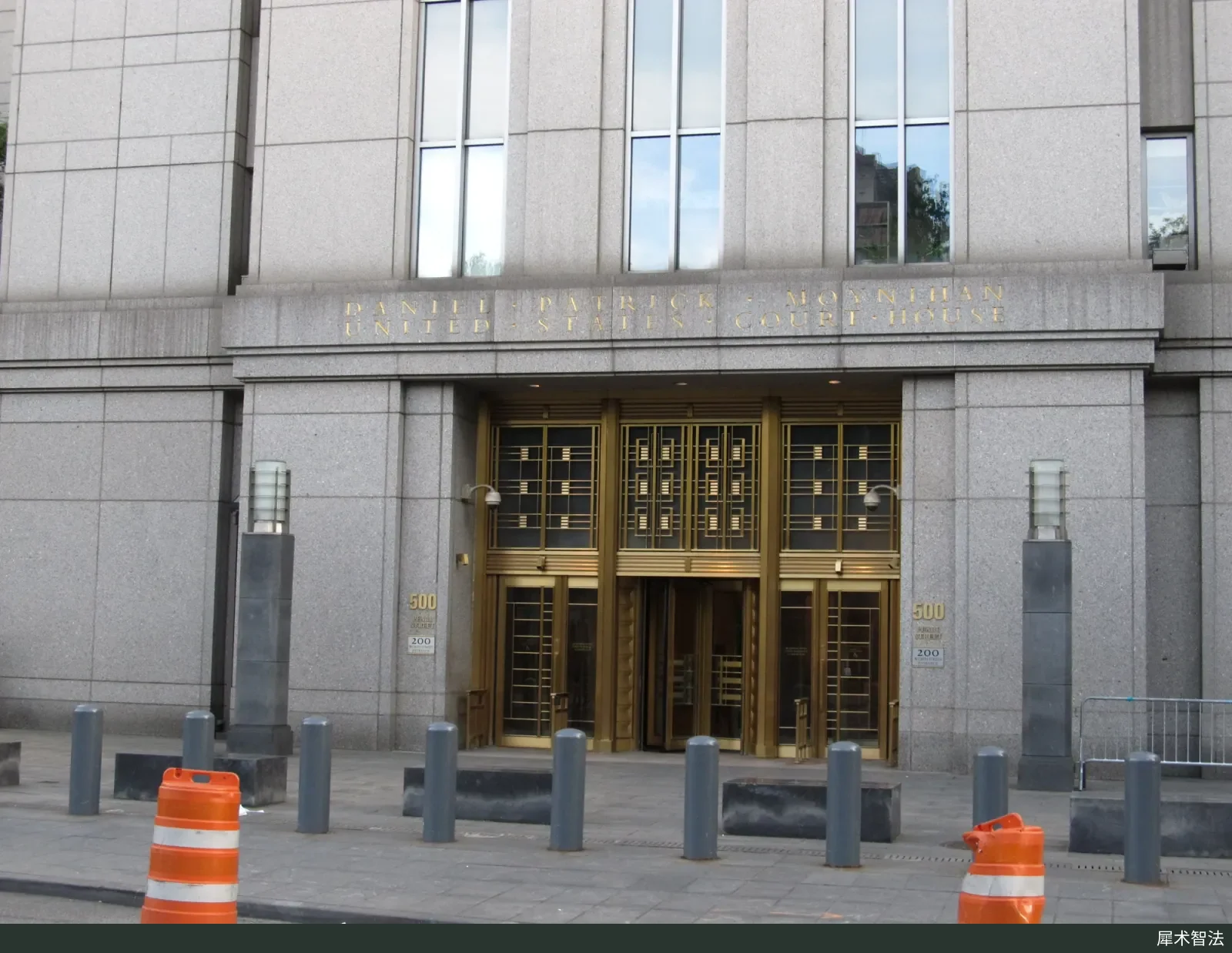
The Daniel Patrick Moynihan United States Courthouse (500 Pearl Street) at Foley Square in Manhattan, New York, which houses the U.S. District Court for the Southern District of New York. Photo: Ken Lund; source: Wikimedia Commons; license: CC BY-SA 2.0.
On December 27, 2023, The New York Times Company sued Microsoft and OpenAI in the U.S. District Court for the Southern District of New York (Case No. 1:23-cv-11195), alleging that they used Times articles without permission to train models and reproduced its reporting in chat and search products. In 2025 the court dismissed some of the claims, while the core infringement claims proceeded; in September 2026 the parties filed motions for summary judgment, and the fair use question remains to be decided.
Filing of the Suit and the Plaintiff's Claims
On December 27, 2023, The New York Times Company filed suit in the U.S. District Court for the Southern District of New York. The case is captioned The New York Times Company v. Microsoft Corporation et al., Case No. 1:23-cv-11195. It is presided over by District Judge Sidney H. Stein, with discovery and related matters referred to Magistrate Judge Ona T. Wang. The defendants include Microsoft Corporation and several OpenAI-affiliated entities, including OpenAI, Inc., OpenAI LP, and OpenAI OpCo LLC. The plaintiff filed its First Amended Complaint in August 2024 (ECF No. 170); the court explained in its opinion that the amended version added works at issue but raised no new legal theories or causes of action. On August 21, 2026, the plaintiff filed a Third Amended Complaint (MDL ECF No. 1677).
The following are the plaintiff's allegations, which the court has not found to be true. The complaint alleges that OpenAI's GPT-series models copied and used millions of copyrighted Times articles in training, citing as an example at least 1600 ten-thousands (sixteen million) unique records from the Times in the Common Crawl dataset. On the output side, the plaintiff alleges that GPT-4, when prompted, can output large portions of its reporting nearly verbatim, listing numerous examples in Exhibit J; that search-integrated products such as Bing Chat and ChatGPT's Browse with Bing display excerpts and paraphrases of the original text far longer than traditional search results, diverting readers from the Times website; and that the models also misattribute to the Times content it never published. On this basis the complaint asserts six causes of action: direct infringement, vicarious infringement, contributory infringement, violation of Section 1202 of the Digital Millennium Copyright Act (DMCA) concerning copyright management information, common-law unfair competition by misappropriation, and federal trademark dilution, and asserts that the defendants should be liable for “billions of dollars” in statutory and actual damages.
The Defendants' Principal Defenses
At the motion-to-dismiss stage, the two defendants challenged only some of the claims; apart from the statute of limitations issue, the core direct infringement claim was not targeted for dismissal. OpenAI filed a partial motion to dismiss on February 26, 2024 (ECF Nos. 51 and 52), arguing that direct infringement claims based on training conduct in 2019 and 2020 were barred by the three-year statute of limitations, and challenging the contributory infringement, DMCA, and unfair competition claims. The motion also directly questioned the origins of Exhibit J: OpenAI said the Times “paid someone to hack OpenAI's products,” and that only after “tens of thousands of attempts,” exploiting a bug and using deceptive prompts that violated the terms of use, did it obtain these “highly anomalous” outputs, adding that “normal people do not use OpenAI's products in this way.” According to Reuters, a lawyer for the Times responded that what OpenAI called “hacking” was simply using OpenAI's products. Microsoft also moved to dismiss the contributory infringement, DMCA, and unfair competition claims, among others.
In the summary judgment stage, the defendants' defenses center on fair use. In its memorandum in support of its motion filed on September 4, 2026 (public version, ECF No. 1496), OpenAI argues that pre-training on news works, aimed at distilling broad patterns of human language and facts about the world from massive amounts of text, is a highly transformative use; that the works at issue are primarily factual; and that pre-training has caused no legally cognizable market harm. Citing the analysis of the plaintiff's expert, the memorandum states that verbatim regurgitation is extremely rare, at rates between 0.000002% and 0.00011%. It also argues that the Browse feature's extraction of factual information from articles is fair use or was impliedly licensed, and that the DMCA claims cannot succeed. Microsoft filed a motion the same day (ECF No. 1473) asking the court to enter judgment in its favor on all claims against Microsoft in the Times' Third Amended Complaint; its memorandum (ECF No. 1585) asserts that both model training and Copilot's web retrieval feature (web grounding) are transformative.
The Court's Procedural Rulings to Date
All of the court's rulings so far have been procedural; it has made no merits determination on whether there was infringement or whether the use constitutes fair use. On March 26, 2025, Judge Stein first issued a brief order on the motions to dismiss, and on April 4 issued an opinion setting out his reasoning (ECF No. 514), addressing together the three cases brought by the Times, the Daily News, and the Center for Investigative Reporting (CIR). Key points relevant to the Times case include: OpenAI's request to exclude, on statute of limitations grounds, claims based on conduct more than three years before the filing of suit was denied, because the defendant had failed to show that the plaintiff had discovered, or with reasonable diligence should have discovered, the infringement at that time; both defendants' requests to dismiss the contributory infringement claim were denied; the unfair competition by misappropriation claim was dismissed with prejudice; and the DMCA Section 1202(b)(1) claim against OpenAI and the Section 1202(b)(3) claims against both defendants were also dismissed, but “without prejudice,” leaving the plaintiff the possibility of reasserting them.
On April 3, 2025, the U.S. Judicial Panel on Multidistrict Litigation (JPML) centralized multiple copyright suits against OpenAI as In re: OpenAI, Inc., Copyright Infringement Litigation (MDL No. 3143), transferring them to the Southern District of New York for coordinated pretrial proceedings before Judge Stein, under Case No. 1:25-md-03143. The panel found that these cases overlap substantially on factual questions such as model training, and that centralization would reduce duplicative discovery and inconsistent pretrial rulings. Since then, the Times case has proceeded in the same proceeding alongside cases brought by other news organizations and authors' class actions.
ChatGPT user conversation logs have been a major point of contention in discovery. On May 13, 2025, Judge Wang ordered OpenAI to preserve and segregate output logs that would otherwise be deleted, including data users requested be deleted or that must be deleted under privacy regulations (ECF No. 551); according to Bloomberg Law, Judge Stein overruled OpenAI's objection to that order at a hearing on June 26, 2025. On November 7, 2025, Judge Wang ordered OpenAI to produce to the news plaintiffs the full sample of 2000 ten-thousands (twenty million) de-identified ChatGPT conversations, reasoning that even logs not containing Times works could be relevant to OpenAI's fair use defense; on January 5, 2026, Judge Stein overruled OpenAI's objection and upheld that order (MDL ECF No. 1087).
In 2026, the U.S. Supreme Court held in Cox Communications, Inc. v. Sony Music Entertainment that “material contribution” is not a valid theory of contributory infringement liability. On that basis, OpenAI moved under Rule 12(c) of the Federal Rules of Civil Procedure to dismiss the related claims, and the Times and other news plaintiffs subsequently agreed to withdraw, with prejudice, their contributory infringement claims based on that theory with respect to end-user infringement. On August 6, 2026, Judge Stein issued a memorandum order (ECF No. 1449) confirming that withdrawal; as for the Times' and the Daily News' request to amend in order to pursue Microsoft for contributory liability under new theories such as inducement, the court denied leave, finding that the litigation was at a late stage and the plaintiffs had failed to show good cause.
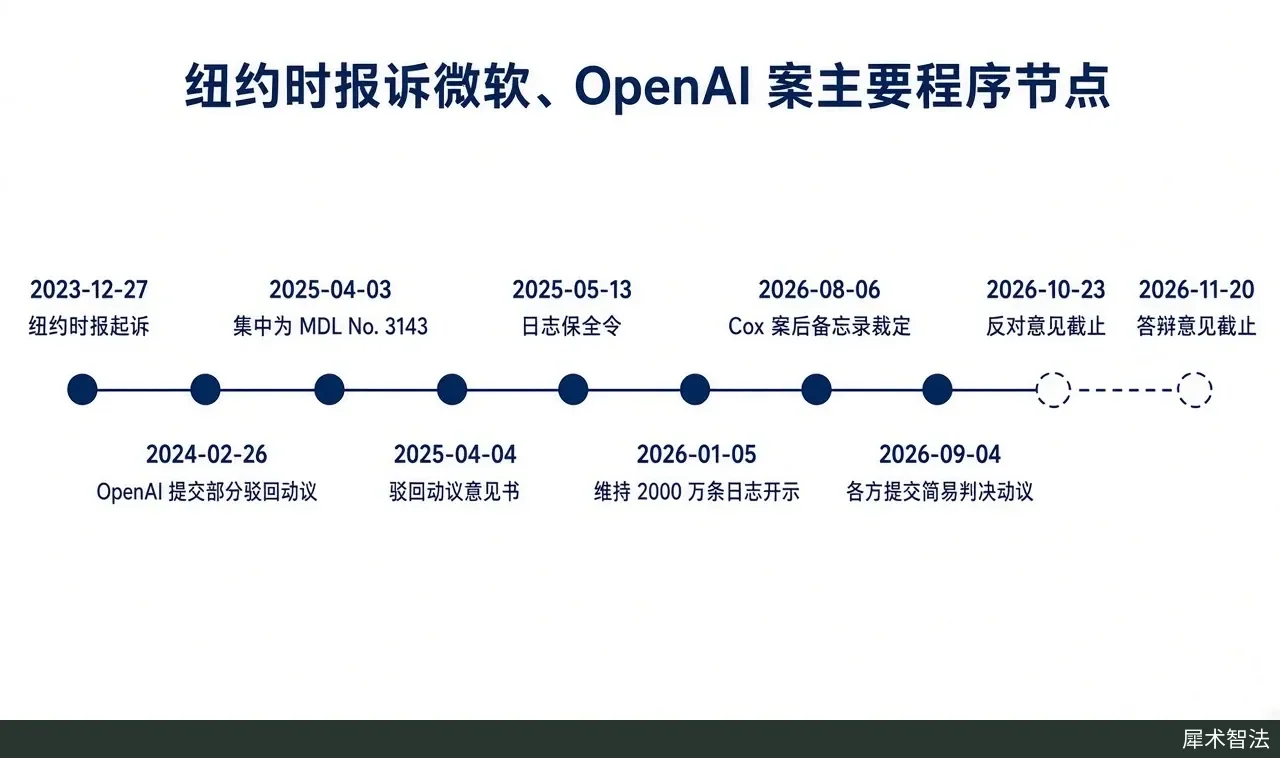
Major procedural milestones in The New York Times v. Microsoft and OpenAI, with dates compiled from public court filings (see References). AI-generated schematic.
Summary Judgment Motions and the Schedule Ahead
On September 4, 2026, the parties filed cross-motions for summary judgment, asking the court to rule on fair use and other issues without a trial. The public redacted version of the news plaintiffs' joint memorandum was entered on the docket on September 17 (MDL ECF No. 1977-1). It asks the court to find that the defendants engaged in unauthorized copying at five stages: acquiring the articles (which the plaintiffs say often involved circumventing paywalls or violating industry norms and terms of use), training the models, Microsoft's use of the Bing index to supply retrieved content for real-time answers, the outputs of Microsoft's products, and the two companies' provision of copies to each other in their partnership. It also asks the court to find that statutory damages can be calculated separately for each infringed article. The memorandum cites the defendants' internal documents and data; for example, the plaintiffs say Microsoft's records show that, compared with traditional Bing search, click-through rates from Copilot to domains associated with the Times and the Daily News fell by 83% to 93%. These are the plaintiffs' interpretations of the evidence, which await the defendants' response and the court's review.
On September 1, 2026, the U.S. Department of Justice filed a statement of interest in the multidistrict litigation (MDL ECF No. 1682), taking the view that training large language models on written works is “highly transformative,” while noting that at the output stage, if a model reconstructs and disseminates the original work, the use may not be transformative. The statement of interest represents the government's position and is not binding on the court.
Under the schedule approved by Judge Stein on September 24, 2026, oppositions to summary judgment are due October 23, 2026, amicus briefs are due October 30, and replies are due November 20. As of this article's verification date (October 23, 2026), the court has not yet ruled on fair use, and the trial date remains to be verified. Until the court rules, the statements in the complaint and the parties' motions are only the parties' allegations.
References
-
U.S. District Court for the Southern District of New York: The New York Times Company v. Microsoft Corporation et al., No. 1:23-cv-11195, Complaint, ECF No. 1, 2023-12-27. CourtListener docket
-
U.S. District Court for the Southern District of New York: No. 1:23-cv-11195, First Amended Complaint, ECF No. 170, August 2024. Original PDF
-
U.S. District Court for the Southern District of New York: No. 1:23-cv-11195, OpenAI Memorandum in Support of Motion to Dismiss, ECF No. 52, 2024-02-26. Original PDF
-
Reuters: OpenAI says New York Times 'hacked' ChatGPT to build copyright lawsuit, 2024-02-27. Article link
-
U.S. District Court for the Southern District of New York: No. 1:23-cv-11195, Opinion on Motions to Dismiss, ECF No. 514, 2025-04-04. Original PDF
-
U.S. Judicial Panel on Multidistrict Litigation: In re: OpenAI, Inc., Copyright Infringement Litigation, MDL No. 3143, Transfer Order, 2025-04-03. Original PDF
-
U.S. District Court for the Southern District of New York: No. 1:23-cv-11195, Output Log Preservation Order, ECF No. 551, 2025-05-13. Original PDF
-
Bloomberg Law: OpenAI Fails To Pare Back Order To Preserve User Data in IP Suit, 2025-06-26. Article link
-
U.S. District Court for the Southern District of New York: No. 1:25-md-03143, Order Upholding the Discovery Order for 2000 ten-thousands (twenty million) Logs, ECF No. 1087, 2026-01-05. Original PDF
-
U.S. District Court for the Southern District of New York: No. 1:23-cv-11195, Memorandum Order, ECF No. 1449, 2026-08-06. Original PDF
-
U.S. Department of Justice: Statement of Interest of the United States, No. 1:25-md-03143, ECF No. 1682, 2026-09-01. Original PDF
-
U.S. District Court for the Southern District of New York: No. 1:23-cv-11195, OpenAI Memorandum in Support of Motion for Summary Judgment (public version), ECF No. 1496, 2026-09-04. Original PDF
-
U.S. District Court for the Southern District of New York: No. 1:23-cv-11195, Microsoft Notice of Motion for Summary Judgment, ECF No. 1473, 2026-09-04. Original PDF
-
U.S. District Court for the Southern District of New York: No. 1:23-cv-11195, Microsoft Memorandum in Support of Motion for Summary Judgment, ECF No. 1585, entered 2026-09-17. Original PDF
-
U.S. District Court for the Southern District of New York: No. 1:25-md-03143, News Plaintiffs' Memorandum in Support of Motion for Summary Judgment (public redacted version), ECF No. 1977-1, 2026-09-17. Original PDF
-
U.S. District Court for the Southern District of New York: Order Extending the Summary Judgment Briefing Schedule, 2026-09-24. Original PDF
-
Xishu Zhifa · Law is the art of the rules of the game
-
Information compiled and published by Scholay, a one-stop academic platform; if there is any infringement, please let us know and it will be taken down.
-
Information also published on Enter Scholar, a community of scholars for the intelligent era