On October 21, 2026, Judge Eumi K. Lee of the U.S. District Court for the Northern District of California, San Jose Division, heard argument on the cross-motions for summary judgment in the case brought by eight music publishers, including Concord, against Anthropic (Case No. 5:24-cv-03811-EKL). The hearing lasted about 4 hours 43 minutes. The dispute centered on whether training Claude on lyrics, and outputs that reproduce lyrics, qualify as fair use, and on the claim that copyright management information (CMI) was removed. The judge did not indicate a leaning from the bench. As of a search on October 24, no written ruling appeared on the docket.
Background of the Suit and Prior Rulings
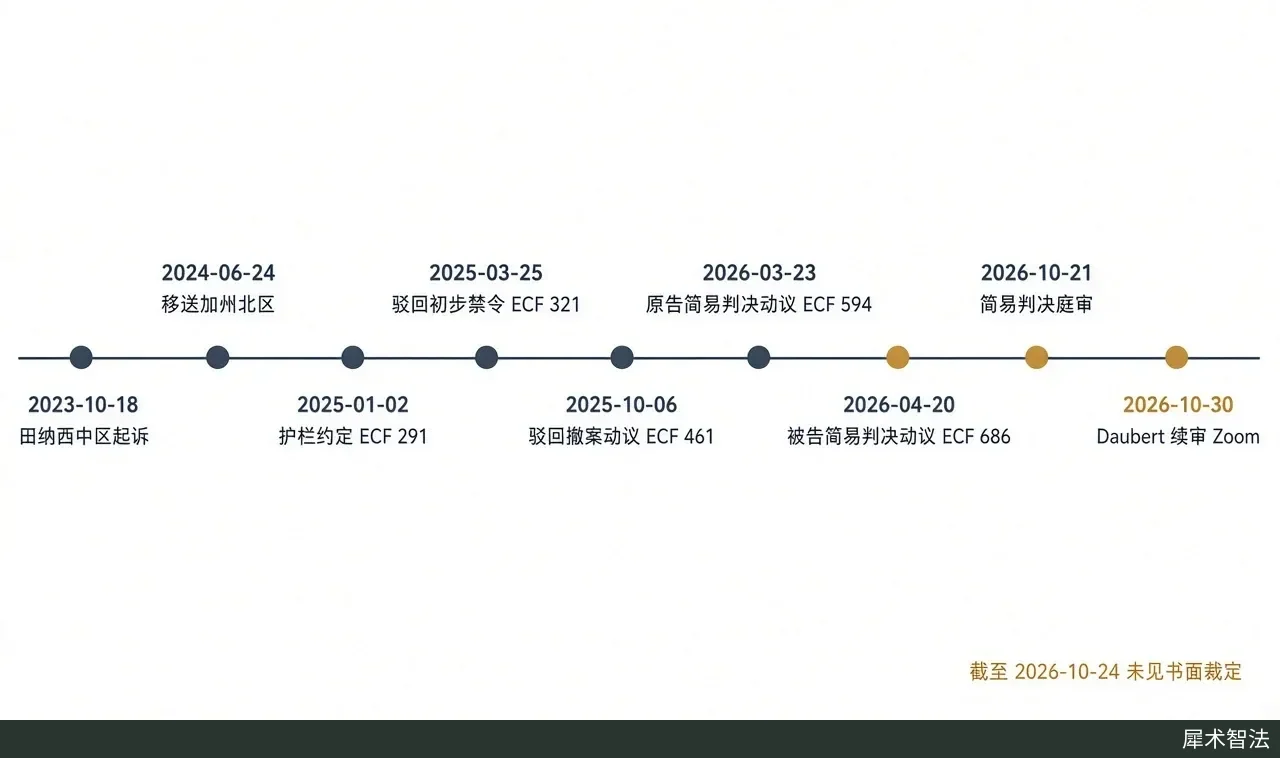
On October 18, 2023, eight publishers sued Anthropic in the U.S. District Court for the Middle District of Tennessee: Concord Music Group, Capitol CMG, Universal Music Corp., Songs of Universal, Universal Music – MGB NA, Polygram Publishing, Universal Music – Z Tunes and ABKCO Music. They asserted four claims: direct infringement, contributory infringement, vicarious infringement, and removal or alteration of CMI (17 U.S.C. § 1202). An exhibit to the complaint listed about 500 musical works, and the amended complaint lists 499. On June 24, 2024, the Tennessee court found that it lacked personal jurisdiction over Anthropic and transferred the case to the Northern District of California. The Northern District's case page records a filing date of June 26, 2024, and on August 21 of that year the case was reassigned to Judge Lee. The above consists of the plaintiffs' allegations and procedural facts and does not represent any finding by the court on whether infringement occurred.
Three earlier rulings bear on the issues at this hearing. First, on January 2, 2025, the court entered a stipulation between the parties (ECF No. 291). Under it, Anthropic would maintain the copyright “guardrails” already in place in its existing models and apply consistent guardrails to the inputs and outputs of new models and products, and the publishers may give written notice if they find the guardrails failing. This was the result of negotiation between the parties; the court did not bar Anthropic from training on lyrics. Second, on March 25, 2025, the court denied the motion for a preliminary injunction because the publishers had not shown irreparable harm (ECF No. 321, without prejudice), and it stated that it was not addressing whether the infringement claims could succeed. Third, in March 2025 the court dismissed the secondary infringement and CMI claims with leave to amend (ECF No. 322). After the publishers amended their complaint, the court denied Anthropic's motion to dismiss on October 6, 2025 (ECF No. 461). It found that the guardrail-related allegations were enough to plausibly infer “knowledge” and that Anthropic may profit from the outputs. It also found that the allegations about the use of a scraping tool called “Newspaper” were enough to support the mental-state element of the CMI claim. The court further explained that at the motion-to-dismiss stage it must provisionally accept the plaintiffs' non-conclusory allegations as true, and that Anthropic's factual defenses could be re-examined at later stages.
A separate case should be distinguished. On January 28, 2026, Concord, Universal Music Publishing Group, ABKCO and others filed a new suit against Anthropic in the same court (Case No. 5:26-cv-00880). That suit alleges that Anthropic downloaded pirated songbooks via BitTorrent and used them for training, and it involves more than twenty thousand works. It is a lawsuit independent of the 2024-numbered case discussed in this article, and the description above likewise consists of the plaintiffs' allegations.
Issues in the Parties' Summary Judgment Motions
The publishers filed a motion for partial summary judgment on March 23, 2026 (ECF No. 594), asking the court to find two things. First, Anthropic copied the 499 works in training and in outputs, establishing the prima facie elements of direct infringement. Second, this copying is not fair use. The motion states that, according to the publishers' own investigation, Claude generated verbatim or near-verbatim lyrics for all 499 works when asked for them directly. It argues that the output lyrics substitute for licensed channels such as LyricFind, Musixmatch and Genius, eroding the markets for lyric licensing and derivative-work licensing. It also argues that “new” lyrics generated by Claude dilute the market, citing the reasoning in Kadrey v. Meta and a U.S. Copyright Office report on this point. In addition, the motion says the publishers have already licensed AI companies such as Udio and Klay Vision for training use, so a market for AI training licenses already exists. All of the above are the plaintiffs' contentions.
Anthropic filed its motion for summary judgment and opposition to the plaintiffs' motion on April 20, 2026 (ECF No. 686), and its reply on September 8 (ECF No. 801). Its argument has four parts. First, training Claude on lyrics is a transformative use that is fair use as a matter of law, as shown by two cases from the same court, Bartz v. Anthropic and Kadrey v. Meta. Anthropic concedes, however, that there is a genuine factual dispute over whether non-verbatim outputs that quote lyrics are fair use. Second, outputs are triggered by user prompts, so Anthropic should not bear direct infringement liability. The motion states that a sample of about five million (500 ten-thousand) prompts and outputs was drawn from the six months before and after the suit was filed. In that sample, more than 83% of the prompts that led to reproduction of the lyrics at issue came from the publishers themselves or their agents. Third, the DMCA claim fails. The works at issue are musical works as a whole, Anthropic scraped only the lyrics, and the publishers have not shown that the “Newspaper” tool actually removed CMI from the works at issue. Fourth, the publishers submitted registration deposit copies for only 13 works and lack a baseline for comparison for the remaining 486, so they should not obtain summary judgment on the “copying” element.
The secondary infringement claims have changed. According to Anthropic's motion, the publishers gave notice on the evening of April 19, 2026 that they would no longer pursue the contributory and vicarious infringement claims. They filed a notice of voluntary dismissal the next day (Dkt. 685). The parties disagree on how those claims should end: Anthropic asks that they be resolved by “entry of judgment,” so that the same issues cannot be raised again in the second case. This article could not verify from the public filings it reviewed how the court subsequently handled the dismissal. The motions were originally set for hearing on July 15, 2026, and were actually heard on October 21.
Highlights of Reporting on the October 21 Hearing
In an on-the-scene report on October 21, Courthouse News reporter Carly Nairn wrote that publishers' counsel Matthew Oppenheim said Claude reproduces protected lyrics, sometimes verbatim. He focused on two kinds of output. The first is “derivative” or mash-up content that quotes or splices together fragments of the original lyrics. The second is “synthetic” songs written to imitate a particular singer's style. He argued that the synthetic songs compete with human works and dilute the music market, saying “it couldn't do that if those lyrics weren't in the database.” Judge Lee pressed him on this logic: would the publishers then have a monopoly over lyrical style, so that no one, including AI, could create new works in the style of older ones without paying a license fee? Oppenheim responded that “copyright is essentially a monopoly.”
The same report states that Anthropic's counsel Sonal Mehta argued that it is users who ask for lyrics or request “a song like Taylor Swift,” so Anthropic is implicated at most in secondary liability. She argued that the model learns from vast amounts of text rather than specifically extracting lyrics, and that the “synthetic” songs Claude generates are new content that will not displace human works. She said “there is no evidence in the record that the music industry is facing devastation.” She also cited expert opinion that Claude has not negatively affected lyric licensing or licensed lyrics platforms such as Genius and LyricFind. All of the above are statements made in court by counsel for the parties, not findings of the court.
The website Chat GPT Is Eating the World quoted the docket's hearing minutes on October 23. According to those minutes, the court heard argument from both sides that day, and the hearing lasted a total of 4 hours 43 minutes. Because time ran out, the remaining Daubert motions concerning both sides' expert witnesses were continued to October 30 at 1 p.m., to be heard by Zoom video. The parties were also ordered to submit two sets of paper copies in the specified manner by October 26. The court's case page further shows that a clerk's notice regarding hearing matters (ECF No. 918) was entered on October 23, along with the parties' filings requesting hearing transcripts (ECF No. 914–916). This article did not review the specific contents of ECF No. 918.
Case Status as of the Search Date
Courthouse News reported that after several hours of argument, Judge Lee took the motions under submission without indicating her view on summary judgment. As of a search on October 24, 2026, the latest filings listed on the court's case page end on October 23, and none of them is a written ruling on the parties' summary judgment motions. The questions at the hearing and counsel's statements reflect only the parties' positions and the issues the judge is focused on, and no outcome can be inferred from them. Likewise, the analysis in the 2025 denial of the motion to dismiss was only a pleading-stage determination and is not a finding of fact. Under Rule 56 of the Federal Rules of Civil Procedure, the court may grant summary judgment only on issues where there is no genuine dispute of material fact; any unresolved issues are left for later proceedings. The next scheduled event is the continued Daubert hearing on October 30.
References
-
U.S. District Court, Northern District of California. Concord Music Group, Inc. et al v. Anthropic PBC, Case No. 5:24-cv-03811-EKL, case page (accessed 2026-10-24). cand.uscourts.gov
-
N.D. Cal., 5:24-cv-03811-EKL, Stipulation and Order re Preliminary Injunction, ECF No. 291 (entered 2025-01-02). CourtListener RECAP
-
N.D. Cal., 5:24-cv-03811-EKL, Order Denying Motion for Preliminary Injunction, ECF No. 321 (2025-03-25). CourtListener RECAP
-
N.D. Cal., 5:24-cv-03811-EKL, Order Denying Motion to Dismiss First Amended Complaint, ECF No. 461 (2025-10-06). CourtListener RECAP
-
N.D. Cal., 5:24-cv-03811-EKL, Plaintiffs' Motion for Partial Summary Judgment, ECF No. 594 (filed 2026-03-23, redacted version). Text hosted by Music Ally
-
N.D. Cal., 5:24-cv-03811-EKL, Anthropic PBC's Motion for Summary Judgment and Opposition to Publishers' Motion for Partial Summary Judgment, ECF No. 686 (filed 2026-04-20). CourtListener RECAP
-
N.D. Cal., 5:24-cv-03811-EKL, Anthropic's Reply in Support of Motion for Summary Judgment, ECF No. 801 (filed 2026-09-08). CourtListener RECAP
-
Carly Nairn. Music labels clash with Claude over copyrighted lyrics. Courthouse News Service, 2026-10-21. courthousenews.com
-
Judge Lee concludes marathon hearing on summary judgment in Concord Music v. Anthropic I; sets 2d hearing to continue Daubert hearing on Oct. 30, 1 PM. Chat GPT Is Eating the World, 2026-10-23. chatgptiseatingtheworld.com
-
Murray Stassen. UMG sues Anthropic for $3bn over ‘brazen’ copyright infringement of 20,000+ songs. Music Business Worldwide, 2026-01-28. musicbusinessworldwide.com
-
Xishu Zhifa · Law is the art of the rules of the game
-
Compiled and published by Scholay, the one-stop academic platform. If this content infringes your rights, please let us know and it will be taken down.
-
Also published on Ente Academic, a community for scholars in the age of intelligence