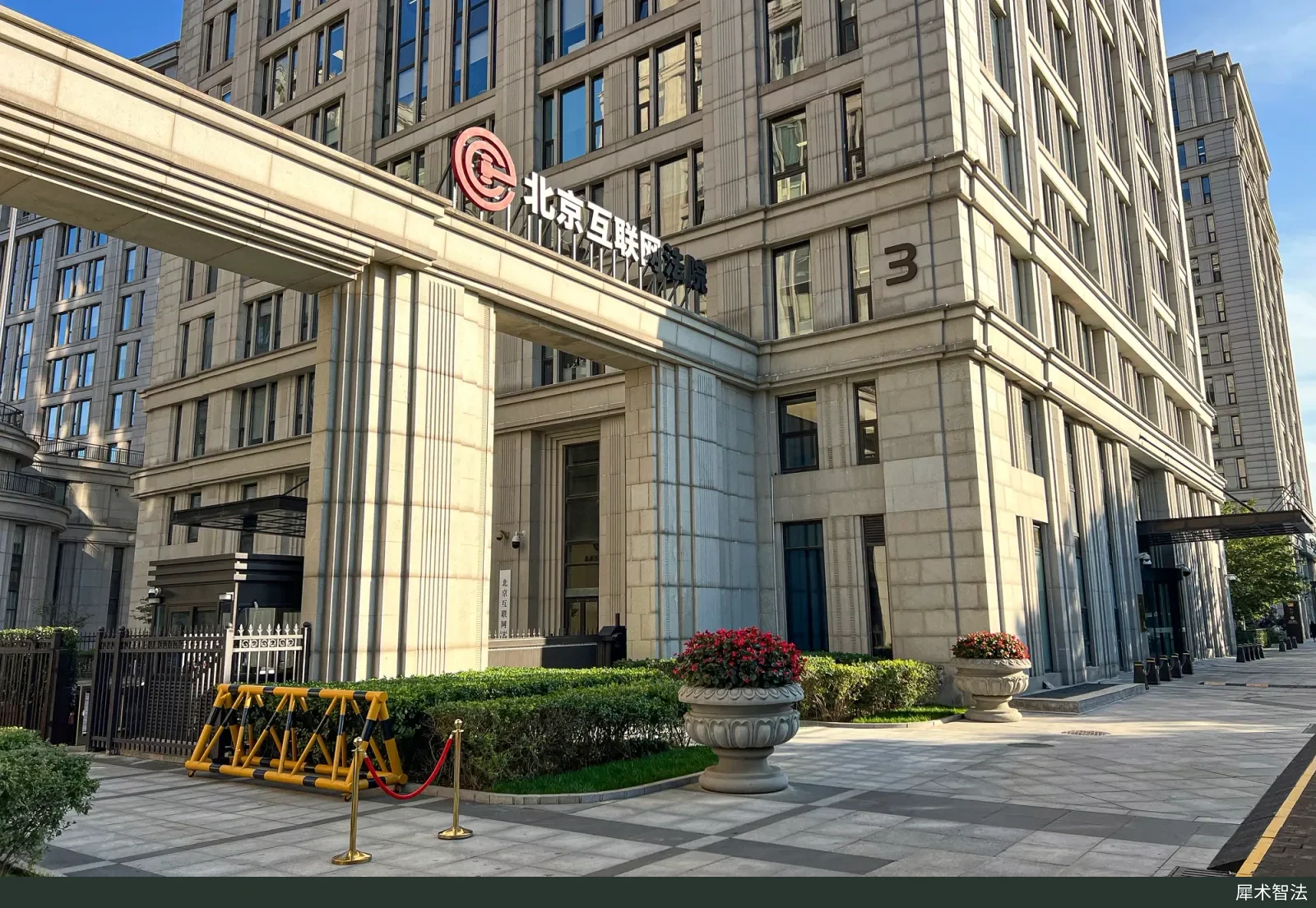
Exterior of the Beijing Internet Court building, photographed on October 20, 2025. Photo: N509FZ; source: Wikimedia Commons; license: CC BY-SA 4.0.
On April 23, 2024, the Beijing Internet Court delivered its first-instance judgment in Yin Mouzhen v. a Beijing Intelligent Technology Company et al., a personality rights dispute, case number (2023) Jing 0491 Min Chu No. 12142. A voice actor's recordings had been turned into an AI text-to-speech product and sold to the public. The court held that as long as an AI voice can be identified as the person by the general public or by the public within a certain scope, it falls within the scope of protection of that person's voice rights and interests, and ordered two companies to jointly and severally compensate economic losses of 25 ten-thousand yuan. The judgment has taken effect and was later included in the People's Court Case Database.
From Audiobook Recordings to an AI Voiceover Product
According to the facts found in the judgment, Yin Mouzhen works professionally in voiceover and broadcasting. In 2019, a certain (Beijing) culture and media company (the “Culture Company”) commissioned her, through an agency, to record two audio works at a recording fee of 90 yuan per hour; the engagement agreement provided that the rights in the recorded works belonged to the Culture Company. On May 10, 2019, the Culture Company signed a Data Authorization and Use Agreement with a certain software (China) company (the “Software Company”), providing it with recording data that included her recording of Chuanyue zhi Huang Mou Tianxia; the Software Company paid a usage fee of 20040.33 yuan for this recording of about 50 hours.
Using only this one recording as material, the Software Company employed artificial intelligence technology to develop a text-to-speech product, which it sold through a cloud service platform operated by a Shanghai network technology company. On January 28, 2022, a Beijing intelligent technology company (the “Intelligent Technology Company”) signed an online service sales contract with a Beijing technology development company, under which the latter placed orders with the Software Company; the order included this product. The Intelligent Technology Company called the product directly through an application programming interface (API), without any technical processing, and launched it as a voice product in the AI voiceover software it operated. The platform page showed a play count of 3256728530.
In May 2023, Yin Mouzhen discovered that several voiceover works online used her voice, and through screening and tracing she identified the Intelligent Technology Company's platform. The court docketed the case on June 12, 2023, and subsequently, at the plaintiff's request, added four other companies as co-defendants. The plaintiff asked that the relevant products be taken down, that the Intelligent Technology Company and the Software Company apologize in writing, and that the five defendants jointly and severally compensate economic losses of 50 ten-thousand yuan and emotional damages of 10 ten-thousand yuan. The court held two public hearings, on December 12, 2023 and April 23, 2024, and pronounced judgment on April 23, 2024. During the proceedings, the two companies stated that they had taken the relevant products down in February 2024, which the plaintiff acknowledged in court. Neither side appealed after the judgment was pronounced, and the judgment took effect.
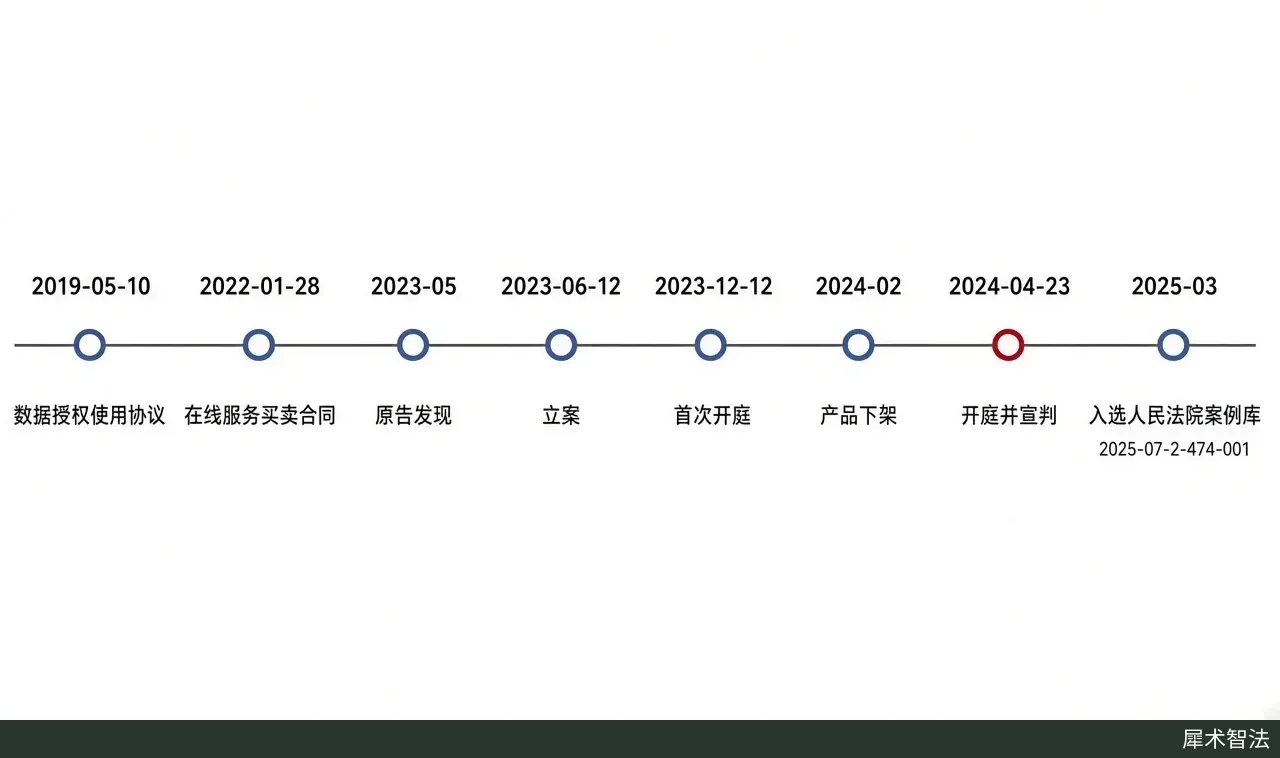
Key dates in the case, compiled from Judgment (2023) Jing 0491 Min Chu No. 12142 and publicly available information in the People's Court Case Database. AI-generated illustration.
Determining the Identifiability of an AI Voice
The first point in dispute was whether a voice processed by AI still counted as Yin Mouzhen's voice. The legal basis is Article One Thousand Twenty-Three, Paragraph Two of the Civil Code: “The protection of a natural person's voice shall be governed, mutatis mutandis, by the relevant provisions on the protection of portrait rights.” Article One Thousand Eighteen defines a portrait as “the external image of a specific natural person by which that person can be identified”; on this basis the judgment reasoned that a voice, like a portrait, is protected by law on the premise that it is identifiable.
The court's explanation proceeded on two levels. The first concerned voices in general: a voice is intangible and invisible, and less identifiable than a portrait, so a specific person can usually be recognized only after repeated or long-term listening; for people in professions such as voiceover, identifiability can be established as long as listeners within a certain scope can map the voice one-to-one to the person. The second concerned AI voices: the key is whether a specific natural person can still be identified, and as long as the general public or the public within a certain scope can identify the person by timbre, intonation and pronunciation style, that natural person's voice rights and interests “extend to that AI voice.”
The defendants had argued otherwise. The Software Company contended that identifiability should be judged by what the general public knows, and that it would be difficult to identify the plaintiff from an AI-processed voice; the Intelligent Technology Company contended that the AI-synthesized voice carried a watermark that severed its connection to the natural person's voice. The court rejected these defenses on the basis of two specific facts: the Software Company had used only the plaintiff's voice to develop the product; and when the court used the product to perform text-to-speech in the courtroom, the resulting voice was “highly consistent” with the plaintiff's timbre, intonation and pronunciation style.
In its press release on the judgment, the Beijing Internet Court summarized this standard as follows: the determination of identifiability “should comprehensively consider how the actor used the voice, and take whether ordinary listeners in the relevant field can identify the person as the criterion.” The adjudicative gist distilled when the case entered the database is: for a voice processed by artificial intelligence technology, where the general public or the public within a certain scope can identify a specific natural person by timbre, intonation and pronunciation style, the voice falls within the scope of protection of that natural person's voice rights and interests; use without permission constitutes infringement.
The Authorization Chain and the Liability of the Five Defendants
The second point in dispute was authorization. The court distinguished between two kinds of rights: under the engagement agreement, the Culture Company enjoyed copyright and other rights in the sound recordings, and could also use the plaintiff's name and likeness in distributing them, but this did not include licensing third parties to subject her voice to artificial intelligence processing. The Software Company held a Data Authorization Letter stating that the plaintiff granted it an unrestricted, perpetual, worldwide, royalty-free, irrevocable license to use her voice to create synthetic or derivative voices; but the court found that this letter had not been signed by the plaintiff herself. It had been signed on her behalf by the original agency, without her knowledge, and she did not recognize it.
The Software Company argued that the agency's conduct constituted apparent agency. Because the authorization letter was signed before the Civil Code took effect, the court applied Article One Hundred Seventy-One of the General Provisions of the Civil Law and held that the agency relationship had ended once the original engagement agreement was fully performed, and that the Software Company had no evidence of any appearance of authority to sign the letter on her behalf. Moreover, AI processing of a voice could significantly affect the plaintiff's personal and property interests, yet the Software Company had not reasonably examined whether the signing party was authorized. Apparent agency therefore was not established.
The judgment found that all five defendants had used the plaintiff's voice without permission, infringing her voice rights and interests; but liability was differentiated according to fault:
| Defendant | Role in the chain | Compensation for economic losses | Written apology |
|---|---|---|---|
| Culture Company | Provided the recordings and licensed them to others | Jointly and severally liable with the Software Company for 25 ten-thousand yuan | Not requested by the plaintiff |
| Software Company | Used the recordings to develop and sell the text-to-speech product | Jointly and severally liable with the Culture Company for 25 ten-thousand yuan | Ordered to apologize |
| A Beijing intelligent technology company | Purchased the product and launched it in its voiceover software via API | No fault, no compensation | Ordered to apologize |
| A Shanghai network technology company | Operated the cloud service platform that sold the product | No fault, no compensation | Not requested by the plaintiff |
| A Beijing technology development company | Distributor that placed the purchase order on another's behalf | No fault, no compensation | Not requested by the plaintiff |
For compensation, the court applied fault-based liability (Article One Thousand One Hundred Sixty-Five of the Civil Code) and joint and several liability for joint infringement (Article One Thousand One Hundred Sixty-Eight). The Intelligent Technology Company did not know that the product was unauthorized, bought it at a reasonable price and called it directly without processing; the court held that it had “reasonable reliance” on the product being lawfully authorized. The products sold by the distributor and the cloud platform had a lawful source, and they likewise bore no fault. As for apologies, the plaintiff sought written apologies only from the Intelligent Technology Company and the Software Company; the court found this remedy commensurate with the manner and scope of the infringement and granted it (Article One Thousand). The request to cease the infringement was no longer upheld, because the products had already been taken down.
Neither side offered evidence of losses or gains, so the court set compensation at its discretion at 25 ten-thousand yuan under Article One Thousand One Hundred Eighty-Two. The factors it considered included: the AI voice still reflected the plaintiff's vocal characteristics and could to some extent substitute for her voice, costing her transaction opportunities; the aesthetic experience a voice provides is an important determinant of the market value of such products; the Software Company used only the plaintiff's voice to develop the product, valuing the timbre, rhythm and pronunciation style that had proven themselves in the voiceover market; and the product's play count. The defendant said the play count on the page was manually entered projected data; the court found that the defendant had not adequately rebutted it, and that it had entered the figure knowing users would treat it as real data, so the court accepted the figure. Damages for emotional harm were not awarded because the plaintiff had not proven serious emotional harm (Article One Thousand One Hundred Eighty-Three).
Another detail concerns a settlement agreement. On September 25, 2023, the plaintiff signed a settlement agreement with the Culture Company, receiving compensation of 3.5 ten-thousand yuan and agreeing to withdraw the suit; but the plaintiff did not subsequently apply to withdraw, and the Culture Company and the Software Company proposed a new settlement plan, stating that the new agreement would prevail where it conflicted with the original one. The court held that both sides had expressed an intention to overturn the original agreement, so it could not bind the adjudication of this case. The case acceptance fee of 3300 yuan was borne by the Culture Company and the Software Company.
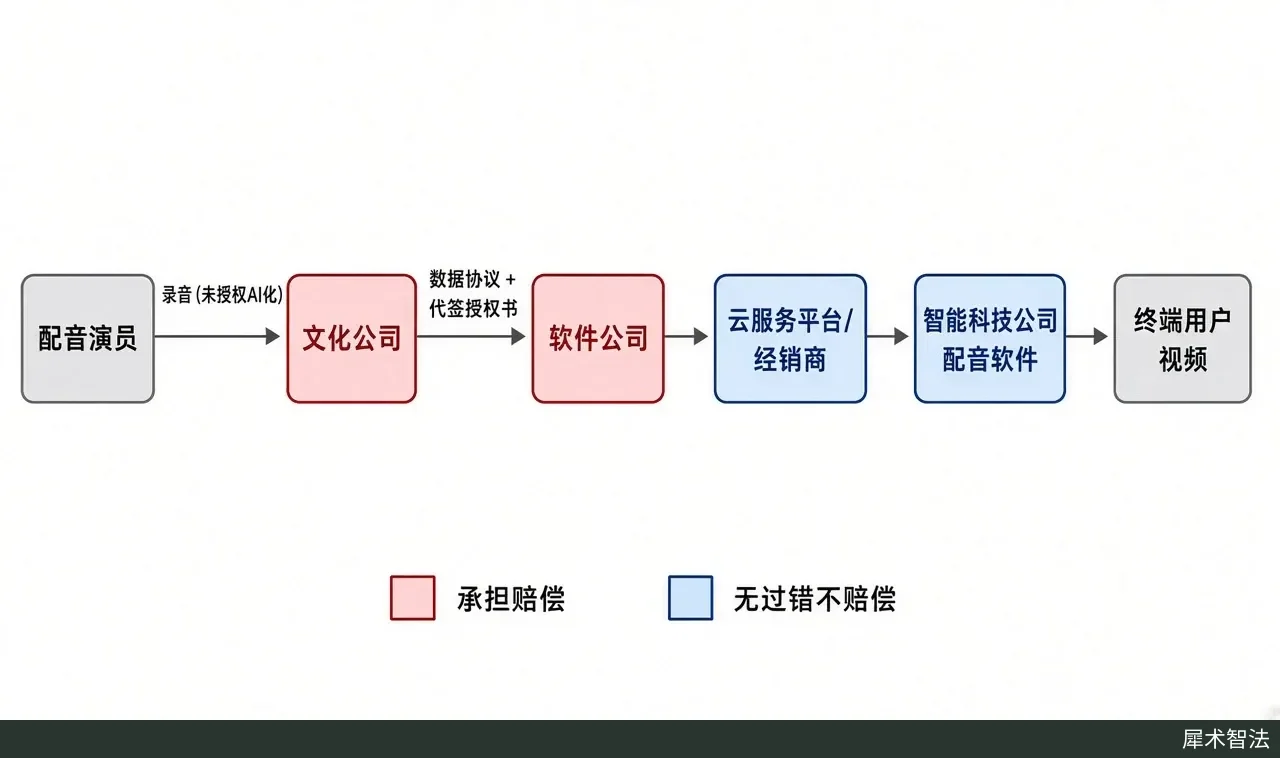
The authorization and transaction chain from the voice actor's recordings to end users' videos: red marks the defendants ordered to pay joint and several compensation, and blue marks the defendants found to be without fault and not liable for compensation. Drawn from the facts found in the judgment; company names follow the anonymized designations used in the judgment. AI-generated illustration.
Lessons for Voice Authorization and the Limits of the Judgment
After the judgment was pronounced, the presiding judge, Zhao Ruigang, vice president of the Beijing Internet Court, said that a voice, as a personality right and interest, is personal and exclusive to the individual: “authorization of a sound recording does not mean authorization to turn the voice into AI; using, or licensing others to use, the voice in a sound recording without the right holder's permission constitutes infringement.” A China Daily report reposted on the Beijing Internet Court's English website also quoted him as reminding companies to be cautious when using AI to process or generate voices and images, and stressing the need to obtain the consent of the persons concerned.
From the judgment's reasoning, three points directly relevant to voice data and voice products can be drawn (the following is this article's summary, not legal advice). First, the object of authorization: copyright and neighboring rights in a sound recording are distinct from the personality right and interest in a voice, and obtaining a recording does not mean obtaining permission to turn the voice into AI. Second, the source of authorization: the judgment denied the validity of an authorization letter signed on the person's behalf and, on the ground that AI processing can significantly affect the person's interests, required the developer to verify that the authorization truly came from the person. Third, downstream positions: the purchaser, the distributor and the cloud platform were exempted from compensation because of reasonable reliance, but they were likewise found to have infringed, the relevant products were taken down, and the purchaser was also ordered to apologize in writing.
The judgment also has clear limits. It is a first-instance judgment that took effect because neither side appealed, and after being selected for the People's Court Case Database it serves as a reference for similar cases. The facts of the case were rather unusual: the product was developed using only the plaintiff's recordings, and the in-court comparison showed a high degree of consistency. The judgment does not directly address synthetic voices trained on a mix of several people's voices, or those that do not use the person's recordings but merely sound similar in style; identifiability still has to be judged on the facts of each case. The 25 ten-thousand yuan figure was a discretionary amount set when neither side offered evidence of losses or gains, and should not be treated as a general compensation standard.
References
-
Beijing Internet Court. Civil Judgment (2023) Jing 0491 Min Chu No. 12142. April 23, 2024 (full-text PDF hosted by the third-party website cnipcase.com, not published on the court's official website).
-
Beijing Internet Court WeChat official account. Nation's First AI-Generated Voice Personality Rights Infringement Case Decided at First Instance. Publication date to be verified.
-
China Court Network (reposted by Zhongshan Court Network). Yin Mouzhen v. a Beijing Intelligent Technology Company et al., Personality Rights Dispute. March 20, 2025.
-
Supreme People's Court (reposted by Sina Finance). Reference Case Entered into the Database: Yin Mouzhen v. a Beijing Intelligent Technology Company et al., Personality Rights Dispute, database entry number 2025-07-2-474-001. March 20, 2025.
-
China Daily (reposted on the Beijing Internet Court English website). AI-generated voice mimicry infringes on rights. April 24, 2024.
-
China Daily (reposted on the Beijing Internet Court English website). Court hears nation's first AI voice rights case. December 13, 2023.
-
Zhang Xuehong. AI-Generated Voices Fall Within the Scope of Protection of Natural Persons' Voice Rights and Interests. Legal Daily, May 4, 2024, page 4.
-
Gazette of the Supreme People's Court. Civil Code of the People's Republic of China (continued). Publication date to be verified.
-
Xishu Zhifa · Law is the art of the rules of the game
-
Compiled and published by Scholay, the one-stop academic platform; if this infringes your rights, please let us know and it will be taken down.
-
Also published on EnterScholar, a community of scholars for the intelligent age