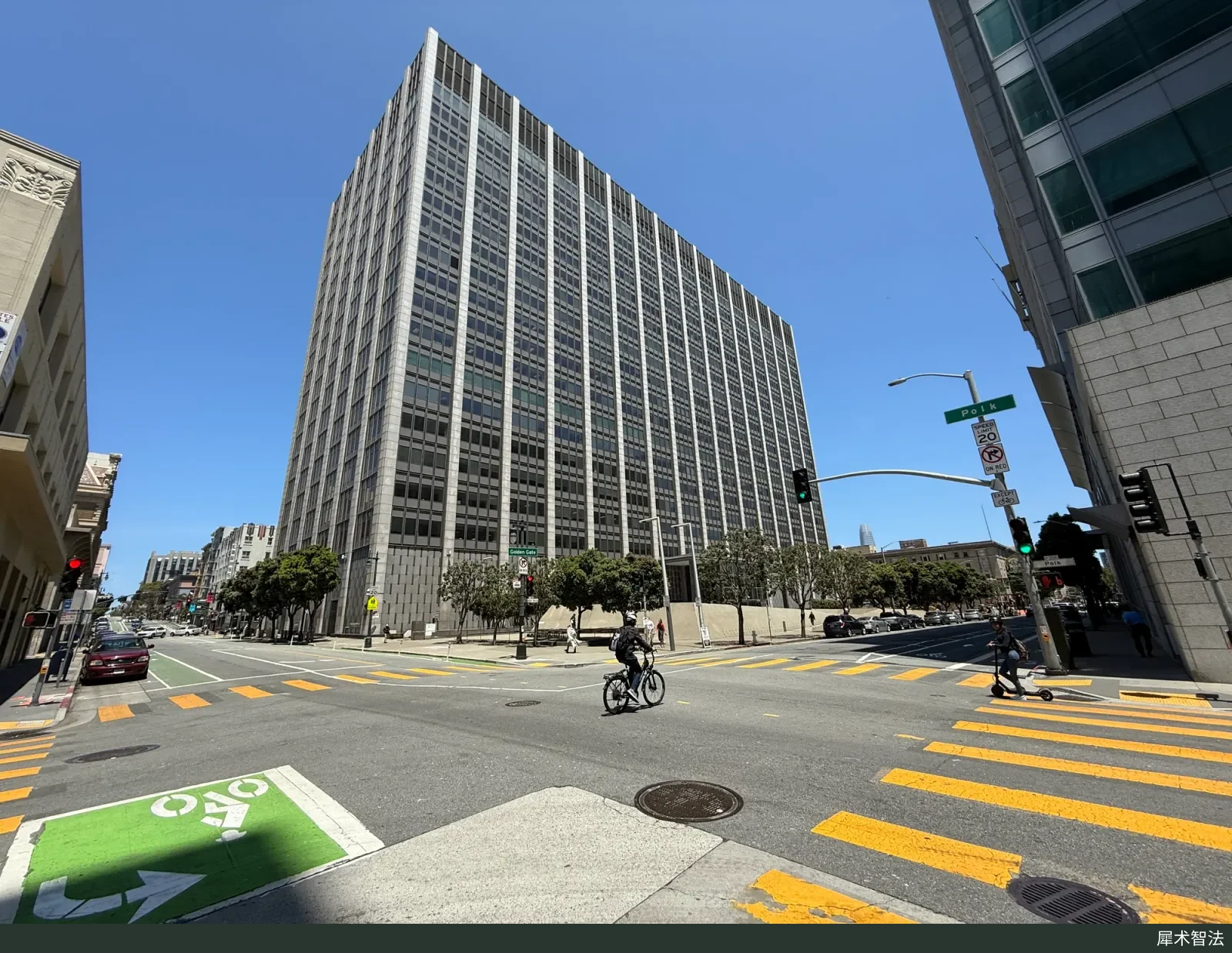
The Phillip Burton Federal Building & United States Courthouse (450 Golden Gate Avenue, San Francisco). The U.S. District Court for the Northern District of California, which is hearing this case, is located in this building. Photo: Marincyclist; source: Wikimedia Commons; license: CC BY-SA 4.0.

In January 2023, three illustrators sued Stability AI, Midjourney, and DeviantArt in the U.S. District Court for the Northern District of California, alleging that the companies used their works without permission to train image-generation models (Case No. 3:23-cv-00201-WHO). Across two rounds of rulings on motions to dismiss, Judge William Orrick allowed the copyright infringement claims and a trademark-law claim against Midjourney to proceed, and dismissed the DMCA claims. These are procedural rulings, not findings of infringement. As of October 2026, the case remains in the pretrial stage.
Plaintiffs, Defendants, and the Allegations in the Complaint
Plaintiffs Sarah Andersen, Kelly McKernan, and Karla Ortiz filed a proposed class action on January 13, 2023, against defendants Stability AI Ltd., Stability AI, Inc., Midjourney, Inc., and DeviantArt, Inc. On January 31 of the same month, the case was randomly reassigned to Judge William H. Orrick. The plaintiffs' core allegation runs as follows: the LAION dataset scraped roughly 5 billion (50 亿) images from the internet, Stability AI used those images to train Stable Diffusion, and the other defendants' products were built on that model. That, the plaintiffs say, is why those products can generate images “in the style of” a particular artist when given the artist's name. All of the above are the plaintiffs' statements in the complaint, and the defendants dispute their accuracy.
Runway AI was not among the original defendants. In the First Amended Complaint (Dkt. No. 129), the plaintiffs added it as a new defendant, alleging that it took part in training and releasing Stable Diffusion 1.5. They also added seven new plaintiffs: Hawke Southworth, Grzegorz Rutkowski, Gregory Manchess, Gerald Brom, Jingna Zhang, Julia Kaye, and Adam Ellis. The August 2024 ruling noted that these additions had been made without prior leave of court. However, because the defendants suffered no substantial prejudice as a result, the court permitted the plaintiffs to keep them in the Second Amended Complaint.
What the Two Rulings on the Motions to Dismiss Kept and Discarded
The first ruling, issued on October 30, 2023 (ECF No. 117), addressed motions to dismiss from three groups of defendants, as well as DeviantArt's special motion to strike under California's anti-SLAPP statute. The court granted most of the motions to dismiss and kept only Andersen's direct copyright infringement claim against Stability AI. She had plausibly alleged that her works were scraped into the training set and used for training, and whether the copying occurred at the training stage or at run time could not be determined at this stage. The claim was limited to her 16 registered groups of works. McKernan's and Ortiz's works had not been registered with the Copyright Office, and their counsel stated in court that no copyright claims would be pursued on their behalf, so their copyright claims were dismissed with prejudice. The direct infringement, vicarious infringement, DMCA Section 1202 (removal or alteration of copyright management information), and right of publicity claims against DeviantArt and Midjourney, as well as the breach of contract claim against DeviantArt, were all dismissed with leave to amend. The California unfair competition law claim was also dismissed, and the court held that the portion based on copyright infringement was preempted by the Copyright Act. The court also denied the motion to strike the class allegations and deferred ruling on the anti-SLAPP motion.
The second ruling, issued on August 12, 2024 (ECF No. 223), reviewed the First Amended Complaint. According to the ruling's conclusions, all of the defendants' motions to dismiss the Copyright Act claims were denied, including the motions directed at the induced infringement claims against Stability AI and Runway. Midjourney's motion to dismiss the Lanham Act (the U.S. federal trademark statute) claims was also denied. Five plaintiffs brought these claims, alleging false endorsement and vicarious trade dress infringement, based on a list of roughly 4,700 artists that Midjourney's CEO had posted on Discord. The DMCA claims were dismissed in their entirety without further leave to amend. The unjust enrichment claim was dismissed, but with one final opportunity to amend. The breach of contract and implied covenant of good faith claims against DeviantArt were dismissed without leave to amend. On DMCA Section 1202(b), the court adopted the reasoning of Judge Jon Tigar of the same court in Doe 1 v. GitHub, holding that such claims require the copy to be “identical” to the original work. The complaint did not allege that Stable Diffusion had ever output an image identical to any plaintiff's work. The court also acknowledged that the question remains unsettled.
| Claim | October 2023 ruling (ECF 117) | August 2024 ruling (ECF 223) |
|---|---|---|
| Direct copyright infringement | Only Andersen's claim against Stability AI kept (limited to registered works); dismissed as to DeviantArt and Midjourney, with leave to amend | All defendants' motions to dismiss denied; claims proceed |
| Induced infringement | Not pleaded as a separate claim in the original complaint | Kept against Stability AI and Runway |
| DMCA Section 1202 | Dismissed, with leave to amend | Dismissed, without further leave to amend |
| Right of publicity / Lanham Act | Right of publicity claim dismissed, with leave to amend | Repleaded as Lanham Act claims against Midjourney; claims kept |
| Unfair competition / unjust enrichment | Unfair competition law claim dismissed | Unjust enrichment dismissed, with one final opportunity to amend |
| DeviantArt breach of contract | Dismissed, with leave to amend | Dismissed, without further leave to amend |
Note: “Kept” means only that a claim survived review at the pleading stage and may proceed to later stages of the case. It does not mean the court found infringement.
The “Compressed Copies” Theory and Discovery
The allegation that “the model contains compressed copies” is one of the plaintiffs' most contested claims. The 2023 ruling found the original complaint unclear on this point and required the plaintiffs to define what they meant by “compressed copies.” If the plaintiffs meant that the model contains mathematical or statistical methods from which training images can be reconstructed algorithmically, they had to say so and plead plausible facts. The theory built on this allegation, that “the model itself is a derivative work,” was likewise dismissed. At the hearing, the parties also disputed how much could be determined from the public code alone. The plaintiffs said they needed information that Stability AI had not made public. Stability AI responded that the only non-public material was the weights files, which had nothing to do with the “compressed copies” question.
The First Amended Complaint added allegations about how training images are retained in the model and how they are called up at run time. It cited two kinds of material. The first was public remarks by Emad Mostaque, then CEO of Stability AI, to the effect that 100,000 GB (10 万 GB) of images had been compressed into a 2 GB file that could “recreate” any one of those images. The second was academic papers showing that Stable Diffusion can generate images that are very similar, or even identical, to some training images. The plaintiffs also pointed out that components such as the weights files are not available for everyone to inspect. The 2024 ruling addressed two theories. Under the “model theory,” the trained model is itself an infringing copy or derivative work. Under the “distribution theory,” distributing the model amounts to distributing the works. The court held that both theories depend on whether the plaintiffs' works exist in some form in the model as it is distributed and run. At this stage, the claims could proceed even if the works exist as algorithmic or mathematical representations fixed in a medium different from that of the originals.
This conclusion rests on the standard of review for motions to dismiss. Under Rule 12(b)(6) of the Federal Rules of Civil Procedure, the court first assumes that the complaint's factual allegations are true and examines only whether the allegations are “plausible.” The ruling states that whether the evidence supports each theory, and whether the plaintiffs must choose among the theories, will be addressed at the summary judgment stage. Whether a fair use defense succeeds must likewise be tested against the evidence. On the model's reproduction of training images, Stability AI calls this a bug while the plaintiffs say it happens by design, and the court said this dispute is “to be tested at a later date.” Procedurally, the court did not find that the model contains copies of the works. It only allowed this theory to proceed to discovery. There, the parties will produce training data and technical materials about the model, and the court will assess the theory at the summary judgment stage.
Proceedings After 2024
According to the plaintiffs' January 2026 motion, the court ordered discovery to begin on October 29, 2024 (ECF No. 240), and the plaintiffs filed the Second Amended Complaint two days later (ECF No. 238). On November 21, 2024, the plaintiffs voluntarily dismissed all DMCA claims in the Second Amended Complaint (ECF No. 241), and McKernan and Southworth withdrew from the litigation as a result. According to that filing, the defendants agreed that if the Ninth Circuit rejects the “identicality” requirement in Doe 1 v. GitHub, they will not cite this dismissal as a reason to oppose a request by the plaintiffs to have the claims heard again. The outcome of that appeal has yet to be verified.
On January 12, 2026, citing material newly disclosed in discovery, the plaintiffs sought leave to file a Third Amended Complaint (ECF No. 376). It added two new direct infringement allegations: that DeviantArt copied the plaintiffs' works to develop DreamUp, and that Midjourney downloaded and used the DataComp xLarge dataset, which contains the plaintiffs' works. The defendants did not oppose the motion, and the court granted it on February 25, 2026 (ECF No. 429). The court also allowed Stability AI and Midjourney to temporarily keep the names of non-public training datasets under seal. The plaintiffs filed that complaint on February 27 (ECF No. 431). These additions are the plaintiffs' allegations, and the court has not yet reviewed them on the merits.
On scheduling, a February 2, 2026 order (ECF No. 409) set the fact discovery cutoff at June 1, 2026, with trial set for before June 1, 2027. On September 28, 2026, Orrick granted the plaintiffs' motion to modify the schedule again (ECF No. 759). The docket entry states that hearings on dispositive motions and class certification must be held by September 29, 2027. The new trial date has yet to be verified. Discovery disputes are ongoing. On September 1, 2026, the plaintiffs filed a motion for discovery sanctions against DeviantArt (ECF No. 730), which is being handled by Magistrate Judge Lisa J. Cisneros. On October 19, a stipulation between the parties resolving that motion was approved (ECF No. 778); its specific terms have yet to be verified. As of the docket check on October 22, 2026, the court had not ruled on whether infringement occurred, on fair use, or on class certification.
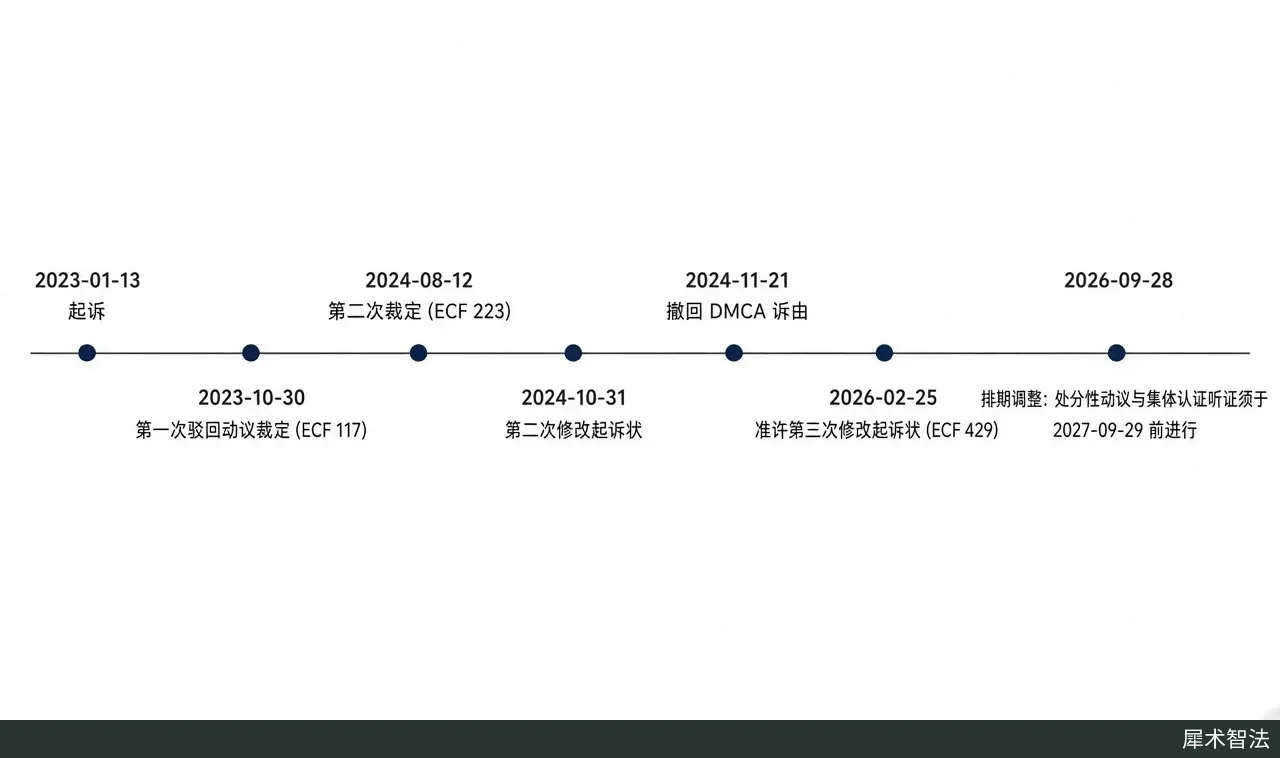
AI-generated schematic: key procedural milestones in Andersen v. Stability AI (January 2023 to September 2026). The court's orders and the CourtListener docket are authoritative for dates and docket numbers.
References
-
U.S. District Court for the Northern District of California, Andersen v. Stability AI Ltd., Case No. 3:23-cv-00201-WHO, Order on Motions to Dismiss and Strike (ECF No. 117), October 30, 2023. CourtListener archived PDF
-
U.S. District Court for the Northern District of California, Andersen v. Stability AI Ltd., Case No. 3:23-cv-00201-WHO, Order Granting in Part and Denying in Part Motions to Dismiss First Amended Complaint (ECF No. 223), August 12, 2024. CourtListener archived PDF
-
Plaintiffs' counsel, Plaintiffs' Notice of Voluntary Dismissal (ECF No. 241), Case No. 3:23-cv-00201-WHO, November 21, 2024. CourtListener archived PDF
-
Plaintiffs' counsel, Motion for Leave to File Third Amended Complaint (ECF No. 376), Case No. 3:23-cv-00201-WHO, January 12, 2026. CourtListener archived PDF
-
U.S. District Court for the Northern District of California, Order Granting Unopposed Motion for Leave to File Third Amended Class Action Complaint and Granting in Part Motions to Seal (ECF No. 429), Case No. 3:23-cv-00201-WHO, February 25, 2026. CourtListener archived PDF
-
U.S. District Court for the Northern District of California, Order Granting in Part Plaintiffs' Motion to Modify Case Schedule (ECF No. 409), Case No. 3:23-cv-00201-WHO, February 2, 2026. CourtListener archived PDF
-
CourtListener, Andersen v. Stability AI Ltd., 3:23-cv-00201 (N.D. Cal.) docket, accessed October 22, 2026. Docket page
-
U.S. District Court for the Northern District of California, Andersen et al v. Stability AI Ltd. et al case page. Court website
-
Xishu Zhifa · Law is the art of the rules of the game
-
This information was compiled and published by the Scholay one-stop academic platform. If it infringes your rights, please let us know and it will be taken down.
-
This information is also published on Enter Scholar, a community for scholars in the age of intelligence.