
The front façade and dome of the Munich Palace of Justice (Justizpalast), near Karlsplatz in Munich (photographed on 26 August 2010). The building is the seat of the Bavarian Ministry of Justice, whose website published the press release on the judgment in this case. The image shows the building itself, not the courtroom where the case was heard. Photo: Pixelteufel; source: Wikimedia Commons; license: CC BY 2.0.

On 31 July 2026, the Munich I Regional Court in Germany delivered its first-instance judgment in GEMA v. Suno (Case No. 42 O 763/25), largely granting the claims brought by GEMA, the music copyright collective management organization, against the AI music generation service Suno. The court held that the “memorization” of songs in model parameters constitutes reproduction, that the text and data mining exception does not cover storage within the model, and that Suno’s US fair use defense fails. The judgment is not yet final and may be appealed.
Facts of the Case and the Judgment
The plaintiff, GEMA, is Germany’s music copyright collective management organization. In this case it asserted rights in six works: “Atemlos durch die Nacht,” “Rasputin,” “Big in Japan,” “Forever Young,” “Daddy Cool,” and the chorus of “Mambo No. 5 (A little bit of).” Infringement of the lyrics themselves was outside the scope of this case. The defendant, Suno, is a US-domiciled provider of an AI music generation service, and users in Germany can access its US-hosted website. The models at issue are versions v3.5 and v4. The court found as fact that Suno’s training data included these works, and that Suno used “stream ripping” technology to extract and copy them from YouTube. In doing so, Suno circumvented the “rolling cipher,” a technical protection measure YouTube uses to prevent the downloading of audio and video.
GEMA argued that the works were reproduced during training and “memorized” by the model, that the generated outputs constituted further infringement, and that the infringing acts took place in both the United States and Germany. When gathering evidence, GEMA entered only the original lyrics, the music style and the song title in the input field, without specifying melody, harmony, rhythm or arrangement. To obtain the outputs at issue for each work, it entered the same prompt between 4 and 176 times; for “Atemlos durch die Nacht” it took 176 times. Suno raised several defenses. It argued that the works at issue are not protected and cannot be recognized in the outputs. It said the model’s weights and parameters are merely patterns learned from the training data and do not contain the training data, and that any similarity in the outputs resulted from prompts narrowing the scope of generation. It argued that training took place in the United States, so US law should apply and the training is protected by fair use, which German courts have no authority to review. It also argued that the outputs came from prompts the plaintiff repeatedly adjusted, so the users’ conduct broke the chain of attribution. Finally, it argued that even if German law applied, the text and data mining exception would protect it.
The court largely granted GEMA’s claims and ordered Suno to stop three types of conduct. The first is reproducing the works in the United States to train AI music models. The second is storing the works in the models in Germany in the form of parameters or other data structures. The third is communicating the works to the public in Germany by providing the models and the music generation application, together with reproducing and communicating to the public adaptations of the works in the outputs. For “Atemlos durch die Nacht,” “Rasputin,” “Daddy Cool” and the chorus of “Mambo No. 5,” Suno must disclose the extent of its use and its revenue (for acts in Germany, from 1 July 2023 onward), and the court declared that Suno is liable for damages. The court also authorized GEMA to publish the operative part of the judgment in the Süddeutsche Zeitung within six weeks after the judgment becomes final, at Suno’s expense. Suno must also pay pre-litigation attorney’s fees of EUR 5,049.70. The remaining claims were dismissed. The court denied Suno’s requests to stay the proceedings and to refer questions to the Court of Justice of the European Union for a preliminary ruling. The court’s press release states that the judgment is not yet final (nicht rechtskräftig). According to commentary published by Legal500, Suno has announced an appeal.
Memorization in Model Parameters and the Reproduction Right
The court followed the three-stage analysis it had used in an earlier case involving a language model (as described in the WIPO informal summary). The first stage is collecting data and building the training corpus. The second stage is analyzing the data, annotating it with metadata and training the model. The third stage is the user prompting the trained model and receiving outputs. For the claim concerning “reproduction within the model,” the court held that the second stage is the relevant one.
Citing information technology research, the court noted that training data may be retained in a model and can be extracted in the form of outputs, a phenomenon known as “memorization.” During training, the model does not merely extract information from the data; the trained parameters also take on the content of the training data. The court compared the songs in the training data with their reproductions in the outputs and found the songs complex enough and long enough to rule out coincidence. It therefore held that the works at issue are contained in reproducible form in the v3.5 and v4 models stored on servers in Germany. As the WIPO summary puts it, the model parameters encode the content of the works, not merely extracted information or patterns. Accordingly, this memorization constitutes reproduction within the meaning of Section 16 of the German Copyright Act.
The editorial headnotes to the full judgment (margin nos. 262–279) summarize this standard as follows. If a work can be recognizably reproduced through simple, open-ended prompts, it has already been fixed in tangible form, which constitutes reproduction; indirect perceptibility is enough. The fact that a work cannot be seen directly in the model does not affect the reproduction right, though it may bear on whether “making available” is established. Suno’s argument that the parameters represent only statistical patterns and do not store training data was therefore rejected. Legal500’s commentary likewise treats this point as the case’s main interpretation of the concept of “reproduction” in generative AI.
Scope of the Text and Data Mining Exception
Section 44b of the German Copyright Act corresponds to Article 4 of the EU Directive on Copyright in the Digital Single Market. It defines text and data mining as the automated analysis of works to obtain information such as patterns, trends and correlations. The court acknowledged that this exception applies to AI training in principle and can cover the reproductions needed in the first stage to build the training corpus. However, those reproductions were not at issue in this case. What was at issue were the reproductions retained within the model in the second stage, and the court held that these fall outside the exception.
The court reasoned that text and data mining concerns “mere information,” and the statistical correlations a model learns from data are information of this kind. Memorization, by contrast, goes beyond analysis, because the work itself is absorbed into the model parameters. Reproduction within the model does not serve further data analysis, so it is not a “reproduction for the purposes of text and data mining.” It also affects authors’ interest in being paid. The court further noted that applying the exception by analogy would place all the risks of memorization on rightholders. That would be inconsistent with the premise in Recital 17 of the Directive that “the harm to rightholders would be only minimal.” Article 53(1)(c) and (d) of the EU Artificial Intelligence Act, which has applied since 2 August 2025, does not change this conclusion.
Section 44b(2) also requires the user to have lawful access to the works. The editorial headnotes to the full judgment (margin nos. 308–310) state that there is no lawful access where a work is obtained by circumventing an effective technical protection measure. Whether a protection measure is “effective” does not depend on whether it can actually prevent circumvention. In this case Suno circumvented YouTube’s rolling cipher, so this fact is also relevant to whether the exception can apply.
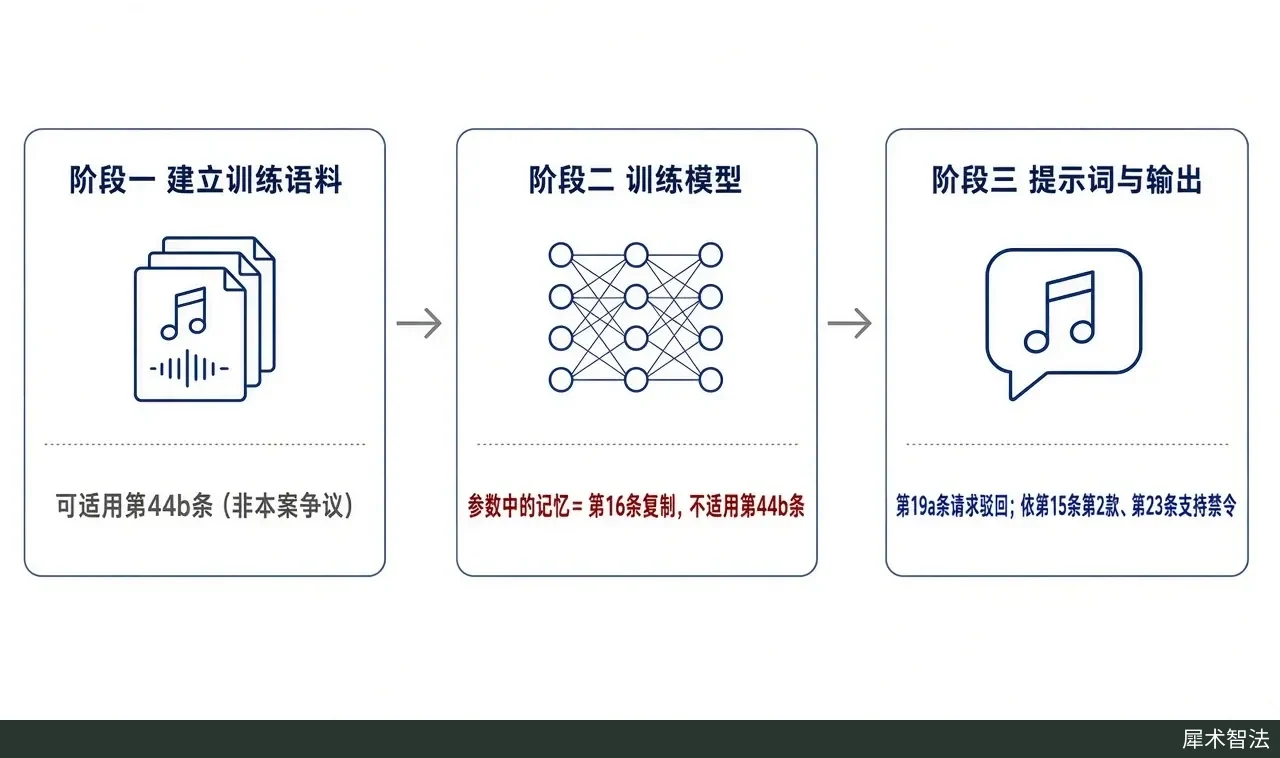
The three-stage analysis used by the Munich I Regional Court in GEMA v. Suno (Case No. 42 O 763/25) and the court’s findings at each stage, compiled from the full text of the judgment and the WIPO IP Judges Forum informal case summary. All provisions cited in the figure refer to the German Copyright Act. AI-generated diagram; the text in the figure has been checked item by item against the main text.
Communication to the Public, Liability for Outputs, and the Fair Use Defense
On “making available” (Section 19a, which requires that members of the public be able to access the work from a place and at a time of their own choosing), the court dismissed GEMA’s claim. GEMA could not show that every prompt would call up the works at issue: it took up to 176 identical prompts to obtain a single output, which does not amount to access at a time chosen by the user. Instead, the court granted the injunction under the general right of communication to the public in Section 15(2) (an innominate right not listed in the statute). As the editorial headnotes (margin nos. 372–379) summarize, providing the model and the music generation application in itself gives the public a way to access the memorized works. As long as simple, open-ended prompts can reach the works, this is a direct act of communication, regardless of whether the works are actually retrieved.
As for the outputs, the court held that, despite differences from the originals, at least one protected original element of each work could be recognized in the outputs. This constitutes reproduction and communication to the public of adaptations (Sections 16 and 23), and the two do not need to be distinguished. Liability lies with Suno, not with users. The prompts were simple and open-ended, giving only lyrics and style, while Suno selected the training data, trained and operated the model, and is responsible for the model architecture and its memorization; it was therefore the model that determined the content of the outputs. The court also held that the liability exemption in Article 6 of the EU Digital Services Act does not apply, because these outputs are the model operator’s own information, not third-party information provided by users.
For the reproductions made during training in the United States, the court found that it had jurisdiction under Section 131 of the German Collective Management Organizations Act. It applied US law under the lex loci protectionis principle in Article 8(1) of the Rome II Regulation, and ascertained US law of its own motion under Section 293 of the German Code of Civil Procedure. Drawing on US Supreme Court precedents including Warhol, Campbell and Sony, the court examined each of the four fair use factors and found that all of them weighed against Suno. The outputs are substantially similar to the originals, with no transformation of content; the use has a commercial purpose; and circumventing technical protection measures shows a lack of good faith. The court distinguished this case from Bartz v. Anthropic and Kadrey v. Meta. In those cases, the training data was not made available to users through outputs, or not to a substantial extent. Here, by contrast, simple prompts alone produced recordings substantially similar to the originals. On this basis, the court issued an injunction under 17 U.S.C. § 502(a) and declared liability for damages under § 504(a). In this part of the judgment, the outputs served only as evidence that the training reproductions took place; they were not themselves the subject of the claims under US law.
As for commentary, an article by Luca Guidobaldi published by Legal500 (20 October 2026) argues that the judgment’s understanding of “reproduction” differs from the approach taken by the High Court of England and Wales in November 2025 in Getty Images v. Stability AI ([2025] EWHC 2863 (Ch)). The article also describes this as the first time such principles have been applied to music. Readers should keep the limits of this judgment in mind. It is a first-instance judgment that can be appealed. Its conclusions rest on six works, two model versions (v3.5 and v4), and the output evidence submitted by the plaintiff. Its assessment of US fair use reflects how a German court ascertained and applied foreign law in this particular case.
References
-
Munich I Regional Court (Landgericht München I), 42nd Civil Chamber: Judgment (Endurteil) in GEMA v. Suno, Case No. 42 O 763/25, 31 July 2026. Full text on the Bavarian legal information platform: https://www.gesetze-bayern.de/Content/Document/Y-300-Z-BECKRS-B-2026-N-17961?hl=true
-
Bavarian Ministry of Justice / Munich I Regional Court: Pressemitteilung 16 vom 31.07.2026 – Urteil GEMA gegen SUNO (Case No. 42 O 763/25), 31 July 2026. https://www.justiz.bayern.de/gerichte-und-behoerden/landgericht/muenchen-1/presse/2026/16.php
-
WIPO Lex: Munich I Regional Court (Landgericht München I), Germany [2026]: GEMA v Suno, Case No. 42 O 763/25 (judgment information page; page date not given). https://www.wipo.int/wipolex/en/judgments/details/3890
-
WIPO: 2026 WIPO IP Judges Forum Informal Case Summary – Munich I Regional Court (Landgericht München I), Germany [2026]: GEMA v Suno, Case No. 42 O 763/25 (informal case summary; publication date not given). https://www.wipo.int/wipolex/en/text/600716
-
Luca Guidobaldi: GEMA v. Suno: A New European Precedent On The Relationship Between Generative AI And Copyright, Legal 500, 20 October 2026. https://www.legal500.com/intelligence/germany/intellectual-property/gema-v-suno-a-new-european-precedent-on-the-relationship-between-generative-ai-and-copyright
-
Xishu Zhifa · Law is the art of the rules of the game
-
Compiled and published by Scholay, the all-in-one academic platform. If you believe this content infringes your rights, please let us know and it will be taken down.
-
Also published on Ente Academic, a community for scholars in the age of intelligence